Understanding Commercial Exhaust Systems
Types of Industrial Ventilation
Heat, fumes, and fine dust do not disappear on their own. They accumulate, degrade equipment, and threaten worker health. Understanding industrial ventilation starts with recognising that every facility has unique air demands. A commercial extractor fan durban, for instance, must match the specific source of pollution it serves, not just the size of the room.
The types of industrial ventilation are best understood by their function:
- General exhaust ventilation dilutes airborne contaminants across an entire space.
- Local exhaust ventilation captures pollutants directly at the emission point.
- Replacement air systems maintain pressure balance when exhaust fans operate.
Each type requires different fan capacities, ductwork designs, and filter arrangements. I have seen facilities waste money on oversized systems because they ignored this distinction!
How Extractor Fans Operate
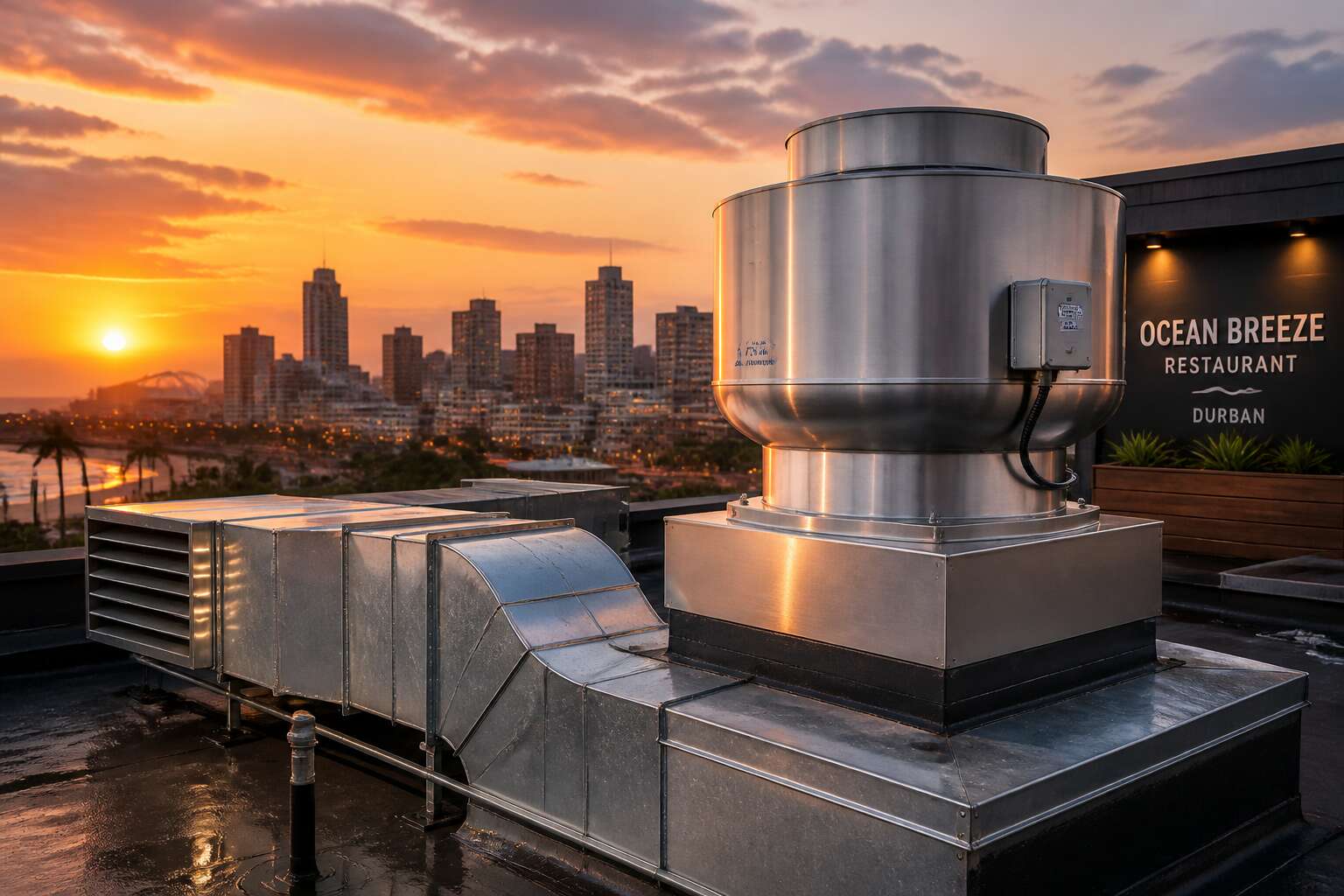
The humid, salt-laden air of Durban is a relentless adversary for any mechanical system. Within this coastal climate, the commercial extractor fan durban facilities rely upon must do more than simply spin; they must wage a constant war against corrosion and moisture ingress. These units are the silent guardians of indoor air quality, pulling stale, contaminated atmospheres from a building’s core and expelling them into the external environment.
A true understanding of how these systems operate begins with the physics of pressure differentials. An extractor fan creates a negative pressure zone behind its blades, compelling air to move from areas of higher pressure to this lower pressure void. The efficiency of this process depends on the fan’s impeller design and the integrity of the ductwork. Even a small gap in the ducting will bleed performance, allowing conditioned air to escape and reducing the system’s capacity to remove pollutants.
The specific challenges of the region demand robust engineering. Coastal environments necessitate specific material choices to prevent premature failure.
– Look for fans with epoxy-coated casings or marine-grade aluminium.
– Consider direct-drive motors to reduce belt slippage and maintenance.
– Verify the IP rating to ensure protection against water jets and dust.
These components work in concert to ensure the unit delivers its rated airflow over its intended lifespan. The system’s ability to preserve its negative pressure equilibrium is what prevents fumes from lingering and keeps the internal environment tolerable for its occupants. Such precision is an engineering mandate for any commercial extractor fan durban operation, ensuring the machinery does not simply operate, but endures.
Key Benefits of Air Extraction
Durban’s atmosphere holds more than a trace of the Indian Ocean’s salt and humidity. Within this coastal theatre, a commercial extractor fan durban business installs becomes an instrument of preservation, not merely a component of climate control. The act of extraction quietly shapes the daily rhythm of a workspace, removing the invisible burdens that accumulate in the air we do not notice until they become unbearable.
Consider the health of a building’s occupants as the primary beneficiary. The continuous removal of airborne moisture and volatile compounds changes the very character of an interior space. We see this most clearly in the kitchens of Durban’s bustling restaurants, where the visible haze of cooking oil and the sharper, sharper tang of frying fish must be drawn away before they settle on every surface. The extraction process dilutes potential respiratory irritants, reducing the strain on the human body. It is a quiet form of hospitality, extended to both staff and patrons.
Beyond human comfort, the structural integrity of the building itself relies on this constant airflow. The corrosive influence of the seaside climate is a known threat. A ventilation system that works to expel dampness actively protects the steel reinforcements and electrical fittings that would otherwise rust from the inside out.
– Prevents the build-up of condensation that leads to mould growth.
– Limits the corrosive action of salt-laden moisture on critical equipment.
– Reduces the risk of airborne grease particles accumulating in ductwork.
The subtleties of air pressure within a building also contribute to operational efficiency. When a commercial extractor fan durban unit performs its task correctly, it prevents the exchange of air from unhygienic zones to clean ones. This pressure management is particularly vital in spaces that handle food preparation or sanitation, where the flow of air must be directed away from sterile surfaces. The design of such systems is a study in deliberate airflow, a strategy to keep the environment in a state of controlled balance. There is a performance aspect that is often overlooked: the removal of hot, stagnant air reduces the load on air conditioning units, which keeps energy bills lower and extends the lifespan of those expensive cooling systems.
I recall a conversation with a facility manager in the Point precinct, who described the installation of a new extraction unit as the moment his warehouse finally felt like a place where work could be done without fatigue. That is the true measure of value. The correct integration of a commercial extractor fan durban system is an investment in the longevity of a business, its equipment, and its people. When the air moves with purpose, the work within a space moves with more ease.
Typical Commercial Applications
A commercial extractor fan Durban business relies on is rarely a single, dramatic machine. It is more often a network of ducts, housings, and impellers working in concert, a circulatory system designed for a specific purpose. The engineer’s task is not simply to remove air, but to choreograph its movement. In a coastal city where the atmosphere itself is a variable, the configuration of these systems requires a level of foresight that goes beyond standard installation. The placement of intake points, the diameter of the ducting, and the velocity of the airflow all dictate how effectively a space can breathe.
The true measure of a ventilation design emerges in its application. Each sector demands a different response from the mechanical heart of the building. The complexity is not in the machinery itself, but in the adaptation to the environment it serves.
– Restaurants and commercial kitchens require high-velocity extraction to capture heat plumes before they spread.
– Manufacturing plants prioritize the removal of particulates and fumes generated by industrial processes.
– Indoor parking garages rely on carbon monoxide sensors to trigger purge cycles that maintain safe air quality.
– Laundry and textile facilities focus on the expulsion of humid, lint-laden air to prevent fire hazards.
The distinction between these environments informs every decision, from the motor power to the material of the ductwork. A system designed for a warehouse in Springfield cannot simply be transplanted to a restaurant on Florida Road without significant alteration. The specific gravity of the contaminants, the ambient temperature, and the building’s envelope all play a role. This is where the expertise of a local installer becomes indispensable, translating the abstract principles of airflow into a tangible solution that meets the demands of a particular business. The quiet efficiency of a well-specified unit is a testament to this planning, a constant, unacknowledged partner in the daily operations of the city’s commerce. The extraction process becomes a silent logic, an answer to the very specific question of what a space contains and what it must expel.
Durban’s Unique Ventilation Challenges
Humid Subtropical Climate Impact
Humidity in Durban routinely hits 80 percent during summer, and that moisture carries salt from the Indian Ocean. This specific combination rapidly degrades standard ventilation equipment, causing corrosion on metal housings and electrical components. The humidity also slows evaporation, meaning surfaces inside a commercial kitchen or factory floor stay damp for longer periods. A commercial extractor fan Durban operation relies on becomes the first defense against this persistent dampness. Without strong, consistent airflow, condensation settles on walls, ceilings, and machinery.
The environment places extreme demands on the unit itself. It must withstand constant moisture and airborne salt particles, which is a common failure point for cheaper models. The priority for any commercial extractor fan Durban facility needs is resistance to these elements. For instance, the motor must be fully sealed, and the blades coated to survive the aggressive atmosphere. The problems are compounded by the heat, creating a difficult cycle. This climate necessitates specific equipment design, not just general-purpose fans. When the air is heavy and wet, moving it requires more torque and sustained pressure, parameters that must be met to prevent premature breakdown.
Salt Air and Corrosion Concerns
Coastal wind carries more than moisture into Durban’s commercial buildings; it delivers a fine salt spray that chemically corrodes every exposed surface. A commercial extractor fan Durban facility uses must withstand this constant exposure. The corrosion begins as tiny pits on the metal housing, then spreads to the motor bearings and electrical terminals.
- Motor windings short out when salt bridges the insulation
- Impeller blades lose balance due to uneven corrosion
- Control switches fail from conductive salt residue
Specifying a commercial extractor fan Durban operation requires means demanding marine grade construction. Epoxy sealed enclosures, stainless steel fasteners, and corrosion resistant coatings are non negotiable. Regular maintenance extends lifespan, but the initial design determines whether the unit continues to function reliably in salt air.
Air Quality in Industrial Zones
Air quality monitors in the South Durban Basin frequently register particulate levels double the national standard. This industrial hub hosts refineries, chemical plants, and manufacturing lines that release sulphur dioxide, nitrogen oxides, and fine dust into the sky.
These pollutants settle on every surface and eventually enter ventilation systems. A commercial extractor fan Durban provides the best results when it expels abrasive particles and corrosive vapours without losing performance over time.
Common contaminants in these zones include:
- Carbon black from tyre production
- Volatile organic compounds from paint and solvents
- Metal oxide fumes from welding operations
Each residue clings to fan blades and motor housings. Reliable extraction removes this pollution before it reaches occupied spaces.
Energy Costs and Efficiency
Electricity in Durban now costs more than R2.50 per unit, and a poorly specified commercial extractor fan Durban can become the largest line item on a facility’s operating budget. In my experience, the culprit is rarely the fan itself. It is the system: an oversized impeller, a misaligned pulley, or a belt that slips after every filter change. These faults force the motor to draw excess current, and the waste multiplies in humid coastal air.
When you choose a commercial extractor fan Durban, the efficiency rating on the brochure means nothing unless the installation matches the ductwork. Here is the checklist we use:
- Verify the fan’s static efficiency rating against the actual duct static pressure.
- Measure motor amperage quarterly and compare it to the nameplate value.
- Confirm that the belt tension matches the manufacturer’s specification.
Each step addresses the specific reason why energy costs spiral in this region. A correctly matched extraction system will move the same volume of air with a fraction of the electricity, and that saving appears on the first invoice.
Local Regulations and Compliance
When the inspector asks about your commercial extractor fan durban, the correct answer is not “it was here when I bought the place.” Durban’s building codes are a peculiar beast, mixing coastal resilience with a sudden passion for odour control. The eThekwini officials expect your extraction system to handle marine mist, banana ripening aromas, and the occasional curry cloud without assaulting the neighbours.
The unique challenge is that rainfall and humidity alter how air pressure behaves across ducts. A system sized for a dry Highveld afternoon will stumble here. Local regulations often demand fire-rated ducting and specific discharge speeds:
– Discharge velocity must exceed 15 m/s at the terminal.
– Exhaust outlets need to clear roof ridges by at least one metre.
– Grease filters require monthly inspection records for restaurant systems.
These rules exist because Durban’s subtropical air traps odours and smoke close to ground level. Compliance is not a suggestion; it is how your business avoids a shutdown notice.
Selecting the Right Extractor Fan for Your Business
Calculating Airflow Requirements
A miscalculated airflow requirement is why most extraction systems fail within the first year. I have audited dozens of Durban businesses, and the pattern is consistent. You need to measure the internal volume of the space in cubic metres, then multiply it by the air changes per hour suited to your operation. A welding workshop demands more than a call centre. This number gives you the base capacity, not the final choice.
Your commercial extractor fan durban selection also depends on these variables:
- Filter type and pressure drop
- Duct diameter and surface friction
- Altitude and ambient temperature
Ignore these, and even a perfectly calculated airflow will disappoint. The fan must match the system curve, not a brochure. That is the practical lesson I share with every client.
Choosing Materials for Coastal Durability
Most fan failures trace back to a mismatch between the impeller and the duct system. The static pressure of your duct run determines the correct blade shape, while your operating hours decide the motor rating. A commercial extractor fan durban that suits a bakery cannot handle a chemical storage area.
For coastal durability, focus on materials that stop salt penetration before it starts. Powder coated mild steel loses its protective layer quickly in humid sea air.
- Aluminium impellers for salt resistance
- Epoxy sealed motor housings
- Stainless steel mounting brackets
These components resist the corrosion that eats standard units. Check the casing and fasteners yourself before purchase. That habit saves countless callouts later.
Noise and Vibration Control
Noise is not a sign of power. In industrial kitchens and factories across Durban, a thundering extractor often indicates the opposite: poor selection and wasted energy. Performance is measured by airflow against resistance, not by decibels. A properly sized commercial extractor fan Durban operations rely on should move air efficiently while sitting quietly in the background, drawing complaints only when it fails to perform.
Choosing between direct drive and belt driven systems matters more than most buyers realise. Direct drive fans align the motor with the impeller, reducing moving parts and, consequently, maintenance. Belt driven units allow for speed adjustment and are better suited for duct runs with high static pressure. For businesses that operate outside regular hours, the lower operational noise of a direct drive model often justifies its higher upfront cost. A fan that ensures exhaust air is removed effectively, without rattling the ceiling, also preserves the sanity of staff working below it.
Vibration is the second culprit. Unbalanced impellers and loose mounting frames cause structural noise that travels through the building. This is not just an acoustic annoyance; it shears bolts and fatigues duct joints. Proper isolation mounts and flexible connectors break the transfer path. Ensuring the base is level and the rotating assembly is dynamically balanced is a simple check that prevents a cascade of repairs. When selecting a commercial extractor fan Durban businesses should request vibration data from the supplier, not just a price quote.
The quietest fan cannot fix a simplistic duct layout. High velocity noise is generated by air rushing past sharp bends. A system with long, sweeping radius elbows operates more silently than a collection of tight 90 degree turns. Ultimately, the correct choice addresses the source, the path, and the receiver. Getting the selection right means lower acoustic output, less structural strain, and far fewer service calls. It is a matter of engineering discipline, not guessing.
Energy-Efficient Motor Options
Motor choice determines the long term cost of any ventilation system. For a commercial extractor fan Durban businesses often default to the cheapest option, yet the motor consumes the majority of lifetime expenses. Electronically commutated motors, or EC motors, adjust speed automatically and draw significantly less power than standard AC motors at partial load. That matters in kitchens that run at full capacity only during peak hours.
Consider the following when comparing motor efficiency:
– Efficiency rating at 25%, 50%, and 75% load, not just full load.
– Compatibility with variable speed drives if you expect fluctuating demand.
– Heat generation inside the fan housing, which affects component lifespan.
A higher upfront price for an efficient motor pays back within a few years. The quiet operation and lower electricity bills are secondary benefits. Selecting the correct motor for a commercial extractor fan Durban installation requires matching the motor curve to your actual duct resistance, not the manufacturer’s brochure.
Evaluating Lifespan and Maintenance Costs
Choosing an extractor system is a negotiation between immediate budget and decade long responsibility. I have watched operators celebrate a low quote, then spend the difference on service visits. The cheapest commercial extractor fan Durban supplier offers often conceals maintenance intervals that erode savings. A unit requiring quarterly belt changes, bearing replacements, or cleaning procedures beyond routine hygiene drains operational funds faster than any energy premium. Lifespan depends on how the fan is built, not merely how it runs. Look for:
- Direct drive motors, which remove belt maintenance entirely.
- Accessible filter housings that allow fast servicing without dismantling ductwork.
- Protective coatings that resist the coastal humidity unique to this region.
A commercial extractor fan Durban business installs should carry a documented service history. Calculating the total cost of ownership, including downtime, reveals which model actually serves your operation.
Comparing Centrifugal vs Axial Fans
I have yet to meet a facility manager who regretted calculating static pressure in advance. The ones who skip it learn the hard way. Centrifugal fans fling air sideways into a scroll casing, generating serious static pressure. Axial fans push air in a straight line, perfect for low resistance environments. Swap these roles, and a commercial extractor fan Durban installation will underperform across every metric that matters.
The decision rests on your ductwork layout and resistance. Before you commit, compare these variables:
- Duct length and number of bends
- Required airflow volume versus static pressure
- Installation space and service access
- Noise tolerance in occupied areas
Measure static pressure, not just airflow. A centrifugal unit handles filters and long runs. An axial unit moves high volumes over short distances. Ask any commercial extractor fan Durban supplier for pressure curves, then verify them against your system’s actual resistance.
Installation, Maintenance, and Upgrades
The Value of Professional Installation
There is a particular tragedy in watching a perfectly good extraction system fail because the installer took shortcuts. In Durban, where humidity does things to metal that would make a shipwright weep, the difference between a correctly fitted commercial extractor fan durban setup and a hastily rigged one shows within months. Professional installation means proper duct sealing, mounting that isolates vibration, and electrical work that survives the coastal environment.
A maintenance schedule in this city cannot wait for annual check-ups. Salt-laden air accelerates wear on bearings and belts. Cleaning fan blades quarterly prevents buildup that reduces airflow and increases motor strain. When energy bills climb despite cleaning, or noise levels rise, consider upgrades. Newer direct-drive models eliminate belt issues entirely.
What a professional installer provides:
– Correct sizing verification for your specific airflow needs
– Duct routing that minimises bends and friction
– Proper sealing against moisture ingress
– Commissioning tests that confirm actual performance
The cost of professional work for a commercial extractor fan durban setup is always less than replacing a failed system prematurely.
Routine Cleaning and Servicing Tips
Routine servicing of a commercial extractor fan durban setup starts with removing build-up before it becomes a problem. A clean filter and an unblocked discharge path do more for airflow than any high-tech adjustment. Set a monthly reminder to wipe down exposed surfaces and inspect the fan guard for debris, especially after seasonal storms that scatter leaves and plastic sheeting across industrial estates.
- Check that foundation bolts have not loosened from vibration
- Verify the manual isolator switches operate without sticking
- Look for condensation trails or rust spots around the motor flange
When servicing uncovers recurring corrosion on terminal blocks or a persistent wobble, take it as a signal to upgrade. Sealed motor units and variable speed controllers handle Durban’s humidity better and adjust to duct pressure changes automatically. These upgrades reduce downtime, which is the real cost driver in any production schedule.
Troubleshooting Common Fan Issues
Most commercial extractor fan durban failures announce themselves long before they halt production. A grinding bearing or an unbalanced impeller leaves audible clues that operators dismiss as background noise. Listen during start-up and shutdown, when rotational forces are most revealing.
When airflow drops unexpectedly, inspect the duct run for obstructions before blaming the motor. A collapsed flexible duct mimics motor failure but costs nothing to fix. Conversely, a motor that trips its overload repeatedly usually points to voltage imbalance or a failing capacitor. We have seen these exact symptoms on factory roofs where a simple cleaning would have saved a costly callout.
- Rapid belt wear signals pulley misalignment
- Vibration that changes with fan speed indicates bearing degradation
- Terminal block corrosion from salt air exposure in coastal plants
A properly commissioned commercial extractor fan durban installation has baseline readings for current draw and vibration. Compare new readings against those records. Direct drive upgrades remove belt-related failures from the equation entirely.



0 Comments