Why Basement Ventilation Matters in South Africa
The Impact of South Africa’s Humid Coastal and Highveld Climates
Walking into a coastal Cape Town basement in January, the humidity hits you immediately! The air hangs heavy with moisture. On the Highveld, the problem flips. Johannesburg’s dry winters crack timber and stir dust, yet summer storms flood the air with humidity. Both extremes punish an unventilated basement.
Mould spores thrive where stagnant air meets dampness. Rust creeps along stored tools. Musty odours seep upward into living spaces. I have seen that ruin more than one family’s prized possessions.
A proper extraction system handles:
- Warm, humid air expelled before condensation forms
- Airborne allergens and dust expelled continuously
- Pressure differences that stop moisture settling indoors
A basement extractor fan south africa must match the local climate, not a generic overseas template. Coastal salt air demands corrosion resistant parts. Highveld dust requires robust filtration. Choose a basement extractor fan south africa built for these realities, or decay claims your basement.
Health Risks of Poorly Ventilated Basements: Mold and Air Quality
South Africans spend up to 90 percent of their time indoors, yet the air in a sealed basement seldom draws attention. That inattention carries a measurable health burden. Respirable mould spores, dust mite allergens and volatile compounds from stored paints migrate upward through floor gaps and service ducts. Children, the elderly and asthmatics feel the effects first. Repeated exposure can trigger rhinitis, bronchitis and general fatigue.
A basement also produces its own pollutants. Concrete outgasses moisture. Stored cardboard harbours fungi. Cleaning agents evaporate into a space that never exchanges air.
I have inspected enough South African basements to know what accumulates over a single winter.
- Respirable dust from stored goods
- Microbial gases from mould colonies
- Formaldehyde from pressed wood
A basement extractor fan south africa directly addresses this burden. It draws contaminated air outward and maintains a pressure balance that stops basement air from invading living spaces.
Protecting Your Home’s Structural Integrity and Resale Value
I have walked through enough Cape Town homes to recognise the smell of a failing basement before the light switch clicks. The stone sweats. The air hangs heavy. What most homeowners never see is the slow deterioration inside their walls. Moisture pushes against mortar. Steel reinforcement rusts and expands, cracking concrete from within. Timber floor joists soften and lose their grip on the bricks above.
The structural damage compounds in silence:
- Spalling concrete and crumbling foundation edges
- Wood rot that creeps into upper floor framing
- Salt efflorescence that signals ongoing moisture migration
A basement extractor fan south africa interrupts this decay. It pulls humid air out and keeps the structure dry, season after season.
That preservation matters at sale time. Serious buyers inspect basements first. They know a damp basement gives them leverage to lower the offer. A dry one is a statement that the home was cared for.
Common Signs Your Basement Needs Better Airflow
Basements in South African homes sit below ground level, where water gathers. Moisture pushes through concrete and masonry without much resistance. Without airflow, that moisture stays trapped. Ventilation matters because a basement that breathes stays dry enough to use. One that does not raises humidity across the whole house and leaves floors cold.
Common signs that airflow has failed are easy to miss until they become obvious:
- Condensation forms on cold water pipes in summer.
- Paint peels in patches that were smooth a year ago.
- Doors at the top of the stairs stick when the weather turns.
Each one points to the same problem: moisture settling where it should not.
A basement extractor fan south africa homeowners trust pulls that moisture out before it settles. It keeps the space dry for storage, a workshop, or a laundry room, and it costs little to run.
Types of Extractor Fans for Basement Spaces
Axial Fans vs. Centrifugal Fans: Which Works Best Below Ground
Basement airflow comes down to a hidden engineering choice: whether the fan can push against resistance. For a basement extractor fan south africa, axial fans move air straight through the blade. They work only with short, open ducting. Centrifugal fans, however, use an impeller to pressurise air and force it through narrow or bending pipes.
Underground, duct runs are rarely direct. They turn around foundations, under staircases, and past stored goods. Centrifugal models outperform axial units in these conditions because they generate static pressure. I have seen a seemingly strong axial fan fail to clear a single room.
Centrifugal fan advantages include:
- Sustained airflow through long ducts
- Better handling of right angle bends
- Resistance to outside wind pressure
This pressure advantage explains why many below ground systems favour centrifugal types.
Wall-Mounted vs. Inline Extractor Fan Configurations
Wall mounted units sit against an exterior wall and vent outside. They suit smaller basements with short duct paths. Inline extractor fans live along the duct run, letting the impeller sit closer to the exhaust point while the intake reaches deeper into the room.
For a basement extractor fan south africa, the choice often depends on moisture patterns. A wall mounted fan extracts from one fixed point, while an inline unit draws from multiple intake grilles. I have seen inline setups outperform wall mounted units in larger basements, and the difference is striking!
- Wall mounted units are simpler to install and service.
- Inline units reduce noise because the fan sits away from living areas.
- Inline configurations handle longer duct runs with greater efficiency.
A basement extractor fan south africa installed inline demands more planning, but offers quieter operation and broader coverage. Wall mounted models give directness.
Humidity-Sensing and Automatic On-Demand Fans
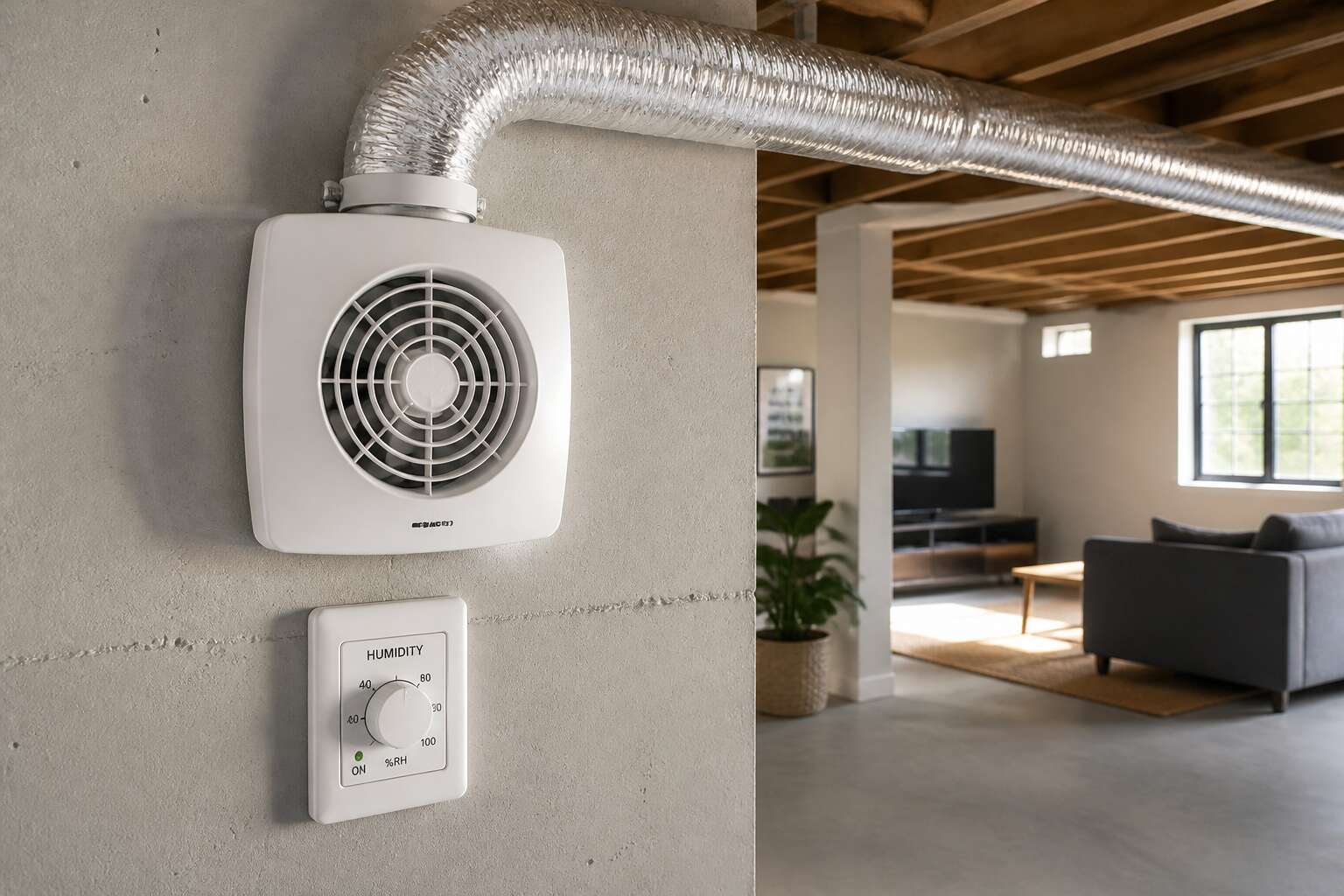
Stale basement air rarely stays predictable. Humidity-sensing extractor fans measure relative humidity in real time and activate when moisture climbs past a set threshold. For a basement extractor fan south africa, this matters in coastal homes where muggy air arrives without warning and in Highveld areas after summer downpours.
Automatic on-demand models operate on similar principles but add motion or odour detection to the mix. The fan runs only when the room genuinely needs extraction, saving electricity and reducing mechanical wear. The tradeoff is that airflow stops once conditions return to normal, which suits basements with intermittent moisture sources rather than chronic dampness. Common features include:
- Adjustable humidity set points
- Post-run purge timers
- Manual override controls
A basement extractor fan south africa equipped with these sensors changes how the room behaves. No timing guesswork, no wasted airflow, just quiet operation until the moment it matters.
Energy-Efficient Models for Continuous Low-Level Ventilation
Ten watts. That is all a modern energy-efficient extractor fan needs to keep a basement breathing around the clock, a yearly electricity cost of roughly R250. A basement extractor fan south africa running continuously needs a brushless DC motor, which drains far less power than traditional AC equivalents.
These low-energy units suit spaces that never quite dry out, or rooms where people spend long hours. The steady exchange keeps carbon dioxide levels low without the dramatic whoosh of a high-powered unit switching on and off. Typical specifications include:
- Power consumption between 6 and 15 watts
- Noise ratings below 20 decibels
- Lifetime lubrication on sealed bearings
Manufacturers now fit these fans with temperature-reactive speed controls, letting the impeller slow down during cool nights and speed up when heat builds. That responsiveness reduces mechanical wear and keeps the room stable.
Understanding Airflow Capacity (CFM) and Static Pressure
Most basement ventilation failures come down to two numbers: CFM and static pressure. Getting those wrong turns a basement extractor fan south africa into an expensive ceiling ornament. Airflow capacity, measured in cubic feet per minute, tells you how much air moves. Static pressure measures resistance from ducts, bends, and filters.
Different fan types handle these demands differently. Mixed flow fans sit between axial and centrifugal designs, offering moderate CFM with decent pressure. For tight spaces, these options matter:
- Ducted centrifugal fans: high static pressure, ideal for long runs
- Mixed flow fans: balanced CFM and pressure for typical basements
- Inline fans: compact, but check the pressure curve for your duct length
A basement extractor fan south africa with a steep pressure curve will sustain airflow when filters or vents are added. Without checking the fan curve, you risk buying a model that stalls under real conditions.
Silent Fans for Finished Basements and Home Theatres
For finished basements and home theatres, noise becomes the deciding factor. A basement extractor fan south africa that sounds like a jet engine ruins the experience. Silent fans use acoustic insulation, vibration isolating mounts, and lower RPM motors.
Consider these options:
- Insulated inline fans with sound absorbing casings
- Remote mounted centrifugal fans installed away from the living area
- Mixed flow fans with variable speed controls
Each type trades off airflow against acoustic comfort. The key is matching the fan’s pressure curve to your duct layout, as we covered above, while keeping the audible level below the room’s ambient noise. In a home theatre, that threshold is often 25 dB or lower. Choose accordingly.
Choosing the Right Fan for South African Homes
Assessing Basement Size, Layout, and Ceiling Height
Subterranean rooms stretch farther than your torchlight can reach. They demand different machines than cramped storage vaults. In South African homes, the volume of air beneath your floorboards, measured in cubic metres, determines extraction power. A low ceiling, hovering two metres above a cold concrete slab, creates a different airflow dynamic than a lofty, converted space.
The layout matters. Each partition, each supporting pillar, obstructs the path of stale air. These obstacles force air to travel tortuous routes. Consider these measurements:
- Total cubic volume of the basement
- Ceiling height at its lowest point
- Obstructions such as pillars, staircases, and angled walls
The shape dictates whether airflow moves in a straight line or snakes through corners.
When selecting a basement extractor fan south africa, consider these physical constraints first. A fan suited to a compact Johannesburg basement will struggle in a sprawling Cape Town footprint. The correct basement extractor fan south africa matches its static pressure rating to the resistance your basement imposes on it.
Matching Fan Capacity to Room Volume and Moisture Levels
A single cubic metre of air holds a finite amount of water vapour, yet saturation shifts with every degree of change. Matching fan capacity to room volume alone is insufficient. You must calculate the moisture load. A concrete cellar in Mpumalanga leaches moisture differently than a sand-filled base in the Karoo.
When I specify a basement extractor fan south africa, I first measure the square footage, then I estimate the vapour pressure. The volume gives the baseline cubic feet per minute. The moisture level dictates the static pressure required to overcome the resistance of damp, dense air. Here are the variables I weigh!
- The hygroscopic nature of the walls and floor
- The frequency of heavy rainfall in your specific province
- The temperature differential between the basement and the living area above
An undersized unit merely circulates the humidity. A correctly matched unit pulls wet air out before it settles on your stored goods. That is the difference between a failed system and a genuine basement extractor fan south africa.
Ducting, Vent Placement, and Outside Air Intake Considerations
The ducting path determines how much work your fan actually does. In South African homes, ducting often runs through crawl spaces or beneath the slab. I prefer smooth metal ducting over flexible plastic, because every rib inside a flex duct creates drag. A crushed bend can cut airflow by a third.
Vent placement changes the pressure picture. Place the extractor high on the wall, where warm, moisture laden air gathers. The fresh air intake should sit low on the opposite wall, so air moves across the floor and carries dampness upward.
- Keep the intake away from car exhaust or sewer vents
- Screen every opening against rodents and insects
- Fit a backdraft damper so outside wind cannot push air backward
Outside air intake adds another layer in coastal provinces. A basement extractor fan south africa must handle humid incoming air as well as the damp generated inside. If the intake faces prevailing winds, use a weatherproof louvre. In Highveld winters, cold intake air chills the basement, so balance fresh air volume against the moisture you must expel.
Installation, Wiring, and Ongoing Maintenance
DIY Installation vs. Hiring a Qualified Electrician
Once your ducting and vent placement are sorted, the actual installation of a basement extractor fan in South Africa becomes a test of your relationship with a screwdriver. Many homeowners attempt the DIY route, which works until you face the electrical box. The wiring is where the comedy ends.
In South Africa, legal requirements and plain self-preservation dictate that a qualified electrician should handle the connections. Paying for professional wiring is cheaper than the alternative. After installation, ongoing maintenance remains your job.
- Clean the fan blades and grille every three months.
- Inspect the ducting for condensation and lint.
- Listen for bearing noise, which signals the motor is failing.
Your basement extractor fan south africa will keep working quietly, provided you give it occasional attention. A schedule is easier to follow than an electrician’s emergency callout fee.
Optimal Fan Positioning for Maximum Air Exchange
Where you place the fan matters as much as the fan itself. In a typical South African basement, dead air collects in corners where humidity pools unnoticed. Mount the extractor on the wall opposite the incoming air source, creating a diagonal cross-flow that sweeps the floor area. Position it too high and you pull moisture off the ceiling while the concrete slab stays damp.
For inline systems, set the unit centrally along the duct run rather than at the exhaust end. This lowers static pressure and lets the impeller work with less resistance. The most overlooked factor is access. A perfect position that requires a ladder every time defeats the purpose.
- Keep the intake grille 30 centimetres clear of any obstruction.
- Angle the discharge vent away from prevailing coastal winds.
- Choose a spot where quarterly cleaning is a job, not an ordeal.
Every basement extractor fan south africa deserves placement that balances airflow, maintenance access, and noise transmission. A basement extractor fan south africa positioned correctly runs quieter and moves more air for every rand of electricity spent.
Electrical Safety and Compliance with South African Wiring Standards
Wiring a basement extractor fan south africa is not a weekend adventure with a multimeter. The South African Wiring Code, SANS 10142-1, exists because damp concrete degrades cable insulation and corrosion attacks terminals. Every connection must sit in a rated enclosure, preferably IP65 or better. Cables running through the basement need mechanical protection, since a stray spade or stored paint tin can compromise the sheathing.
Ongoing maintenance is equally deliberate. Inspect the isolator switch quarterly, test the earth leakage trip, and wipe the impeller without bending its blades. Document each check on the distribution board cover.
- Verify the circuit breaker rating matches the fan motor nameplate.
- Confirm all terminations are torque tightened, not finger snug.
- Replace any gasket that shows cracking before moisture reaches the terminal block.
A basement extractor fan south africa that complies with the code operates without tripping nuisance breakers. That is the quiet sign of a properly installed system.
Cleaning Fan Blades, Filters, and Ductwork Regularly
Once the wiring is signed off, the real work of keeping a basement extractor fan south africa effective begins with routine cleaning. Dust, spider silk, and airborne lint combine to coat the impeller and clog the filter mesh, silently throttling airflow until the motor strains. That strain shortens bearing life and allows humidity to linger where it should not.
A monthly encounter with the fan blades and a quarterly visit to the ductwork prevents most of this:
- Wipe the impeller and filter mesh with a soft brush or vacuum crevice tool.
- Check the grille for dust buildup that restricts intake.
- Run the fan briefly to confirm the airflow feels strong.
For deeper work, the front grille comes off and each blade gets wiped individually. Bending them is a mistake; even a slight distortion creates imbalance and noise. The duct run deserves the same attention. Sagging sections, compressed flexible pipe, and nests of debris all accumulate over time. A blocked duct reduces a powerful basement extractor fan south africa to a weak, noisy version of itself.
Troubleshooting Common Issues: Vibration, Noise, and Reduced Airflow
A basement extractor fan south africa that vibrates or rattles is telling you something. Loose mounting brackets and unbalanced impellers cause most vibration issues. Tighten every screw and check the blade assembly for debris. Loose wiring connections produce their own intermittent hum, so inspect terminal blocks as well.
Noise often comes from the ducting, not the fan itself. Flexible duct with sharp bends creates whistling and turbulence. Straighten the runs or replace kinked sections with rigid pipe.
Reduced airflow has three common causes:
- A clogged filter or grille
- A blocked external vent
- A failing motor capacitor
Work through them in that order. The capacitor is the only component that requires a multimeter. Test it with the power off. If the fan hums but the blades stay still, the capacitor is almost certainly dead. Replace it with the exact same microfarad rating to keep your basement extractor fan south africa running quietly.
When to Upgrade or Replace Your Existing Extract Fan
A basement extractor fan south africa rarely fails all at once. It gives warnings first. During installation, position the housing between joists and level it carefully. Wiring must follow SANS 10142 with the correct cable gauge on a dedicated circuit. I have seen loose terminations cause more field failures than any motor defect.
Ongoing maintenance means checking the backdraft damper every season, separate from blade cleaning. A stuck damper forces the motor to overwork and shortens its service life.
When repair quotes exceed half the cost of a replacement, upgrade. Older shaded pole motors waste electricity. Replace a basement extractor fan south africa that cannot reach its rated CFM after thorough cleaning. That signals permanent wear.
Costs, Regulations, and Energy Considerations in South Africa
Average Pricing and Where to Buy Fans Locally
Pricing for a basement extractor fan south africa fluctuates more than most homeowners expect. I have seen identical models differ by R1,200 between retailers. Expect to pay between R900 and R4,500 for the unit, with certified electrician installation adding R600 to R1,800.
Regulations under SANS 10142 govern all wiring. Municipalities often require mechanical ventilation in habitable basements, and your electrician must issue a Certificate of Compliance after installation.
Energy costs stay modest. A 25W fan running continuously consumes about 18 kWh monthly, roughly R45 on standard municipal tariffs. That is less than one load of laundry!
Where to buy locally:
- Builders Warehouse and Leroy Merlin for axial units
- Specialist ventilation suppliers for centrifugal and inline systems
- Takealot for online deals, though shipping adds R300
Running Costs and Energy Efficiency Ratings
Most buyers fixate on the price tag of a basement extractor fan south africa and ignore the running cost. That is backwards. The purchase price is paid once. The electricity bill arrives monthly.
A standard axial fan rated at 20W to 30W costs around R40 to R50 monthly if run continuously. A centrifugal unit drawing 60W pushes that figure past R120. Tariffs keep climbing, so that gap compounds.
What skews actual consumption:
- Fan type. Centrifugal models consume more to overcome duct resistance.
- Runtime. Humidity sensors cut usage sharply.
- Duct condition. Kinked ducting forces the motor to work harder.
Regulations do not mandate an efficiency rating for a basement extractor fan south africa, but efficiency matters at installation. An inefficient motor might require a dedicated circuit, which raises your electrician’s bill. W per CFM shows how much power a fan burns to move each cubic foot of air. Lower is better!
Municipal Building Regulations and Homeowner Association Rules
A basement extractor fan south africa is seldom mentioned in municipal building plans. That silence carries consequences. In several metros, including Cape Town and eThekwini, basement habitation requires mechanical ventilation under the National Building Regulations. Municipal inspectors may ask for proof of extraction capacity during occupancy certification.
- Concealed duct runs to preserve facade appearance.
- Decibel limits that rule out axial fans near bedrooms.
- Approved installer credentials before any wiring work.
Costs multiply when approvals are retroactive. A fan installed without municipal sign off often forces a second inspection and revised drawings. Energy considerations also shape compliance. A high wattage centrifugal unit might need an upgraded circuit, which triggers electrical certification. The SANS 10400 standard does not mandate energy ratings for extractors, but low wattage models ease the load on older distribution boards. That effect lowers both monthly tariffs and inspection friction.
Warranty, VAT, and After-Sales Support for Local Purchases
When you buy a basement extractor fan south africa from a local distributor, the advertised price always includes 15% VAT. That transparency matters because warranty claims and after-sales support are easier to chase within South African borders. A local supplier will often replace a faulty centrifugal unit within five working days, no shipping delays.
Regulations still apply, of course. The extractor must meet SANS 10400 guidelines, and the installer should provide a Certificate of Compliance for the electrical work. Some municipalities ask for proof of extraction capacity before issuing occupancy certification.
Energy considerations also affect your choice. Low wattage models reduce the load on older distribution boards, which lowers monthly tariffs and simplifies inspection. When comparing prices, factor in the warranty period and the supplier’s technical support, not just the upfront cost.



0 Comments