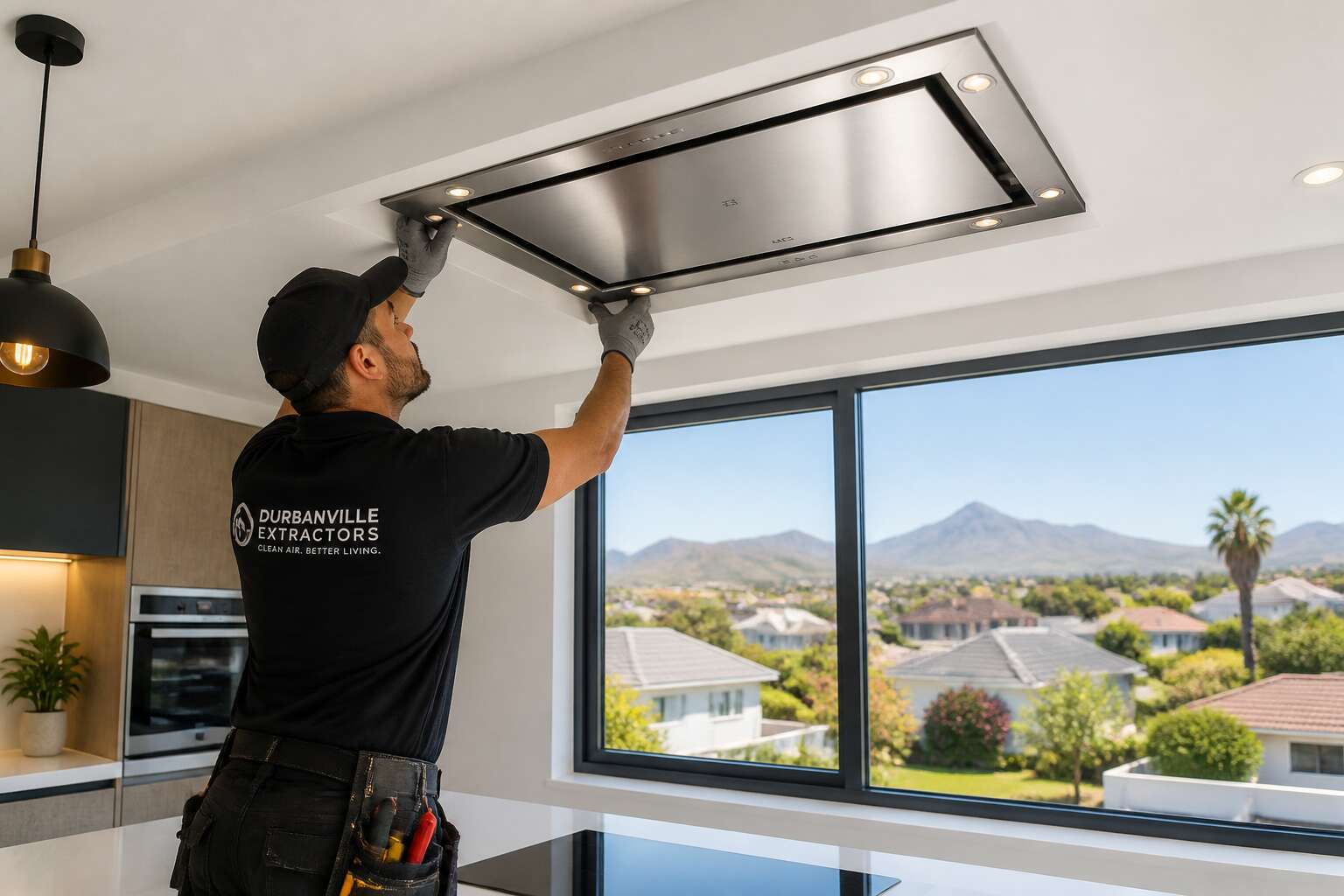
Assessing Ventilation Needs for Durbanville Homes
Understanding Local Climate and Humidity Challenges
Durbanville’s winter rainfall exceeds 600mm, and for weeks the relative humidity stays above 80%. That persistent dampness seeps into walls, leading to mould growth. Extractor fan installation durbanville deserves deliberate thought, not a rushed online order.
Steam from showers or simmering pots settles into ceiling trusses and window frames without mechanical extraction. Summer thunderstorms spike humidity within hours, while winter delivers a steady drizzle. Homeowners often blame bad cleaning, but inadequate airflow is the real issue.
Signs of ventilation failure:
- Condensation on glass each morning
- A sour aroma after cooking
- Dark spots on grout
A properly sized extractor fan installation durbanville, positioned for prevailing moisture, pulls damp air out before it hits the paint. While the weather outside remains damp, your interior stays dry!
Identifying Problem Areas: Kitchens, Bathrooms, and Laundry Rooms
Moisture collects unevenly across your home. The kitchen erupts with steam from a boiling pot, while the bathroom releases a torrent during every hot shower. The laundry room adds its own burden, especially when the dryer vent is blocked. Each space demands a tailored approach to extractor fan installation durbanville.
Walk through your home at peak activity times. Feel the air near the ceiling. Touch the windows. Assess which rooms struggle the most. In many Durbanville homes, these three zones dominate the problem:
- Kitchens, where cooking vapours linger long after the stove cools down
- Bathrooms, where shower steam settles on mirrors and grout
- Laundry rooms, where damp clothing and dryer exhaust create a persistent fug
A single extractor cannot solve every room. You need targeted extractor fan installation durbanville matched to the airflow requirements of each space.
Calculating Airflow Requirements Based on Room Size
Every ventilation challenge begins with arithmetic. The cubic volume of a room, not its floor area, dictates the extraction power you need. A spacious bathroom with a low ceiling demands less than a compact one with lofty proportions. Measure length, width, and height, then multiply.
The standard for bathroom ventilation is eight air changes per hour. Kitchens require ten or more. Extractor fan installation durbanville underperforms without this baseline, yet I find most homeowners skip the maths entirely!
- Multiply the room’s cubic volume by the required air changes per hour.
- Divide that number by sixty to find the extraction rate in cubic metres per hour.
- Compare the result against the fan’s rated capacity.
Durbanville homes often feature open-plan layouts that alter the calculation. Adjoining spaces share air, so the fan must account for movement between rooms. Proper extractor fan installation durbanville hinges on these measurements, not on guesswork.
Factoring in Coastal Weather Patterns and Seasonal Changes
Durbanville sits far enough from the Atlantic to dodge sea spray, yet close enough that maritime air reshapes ventilation needs season by season. Summer’s southeaster carries salt-laden moisture straight into extractor housings, corroding fans rated for inland duty. Winter inverts the problem entirely! The Cape’s rainy season drives humidity inward, but cold air seals every window, trapping damp.
I’ve assessed homes across multiple seasons, and the patterns a single visit misses are striking:
- The southeaster runs from September to March, so fan blades need corrosion-resistant coatings.
- Winter condensation forms before anyone showers, meaning extraction often must run on a schedule, not a switch.
- Spring’s temperature swings cause condensation on duct interiors, which demands insulated ducting.
Extractor fan installation durbanville fails when it ignores these rhythms. A unit chosen for one season underperforms across the year. Matching the hardware to Durbanville’s coastal cycle prevents premature failure.
Selecting the Right Extractor Fan System
Comparing Axial, Centrifugal, and Mixed-Flow Fan Designs
Nobody picks a fan for its good looks. But for extractor fan installation durbanville, the internal design matters more than exterior shine. Axial fans push air straight through, which works fine for short, straight ducts. Centrifugal fans use a spinning impeller to build higher pressure, so they handle long or bendy duct runs without choking. Mixed-flow units borrow from both, giving you a balanced option when space is tight.
- Axial: cheapest, moves lots of air in a straight line
- Centrifugal: strongest against resistance
- Mixed-flow: quieter than centrifugal, more pressure than axial
That’s the short list. The real trick is matching the fan’s curve to your home’s duct network. Get that wrong, and you’ll hear it every time the motor starts.
Choosing Between Wall-Mounted, Ceiling-Mounted, and Inline Units
Choosing between wall, ceiling, and inline units changes how the air travels through your home. For extractor fan installation durbanville, the mounting position is a matter of physics, not preference. Wall mounted fans sit directly in an external wall, so they need the shortest duct path. Ceiling units route moisture upward, useful for bathrooms without an adjacent wall.
Inline fans sit hidden in the duct run, which helps reduce noise near living areas. They also allow multiple rooms to connect to one central extractor system. But each option has a trade off with pressure and access.
- Wall mounted: easiest to install, but limited by wall placement.
- Ceiling mounted: best for steam rise, yet requires attic space.
- Inline: flexible for remote placement, but needs duct planning.
Match the unit to your building’s layout and your daily usage. A wrong selection makes the system work harder, leading to maintenance issues. Think about where the motor will be accessible for cleaning, and how far the duct run actually extends.
Evaluating Noise Levels and Decibel Ratings for Comfort
Silence is the luxury no one budgets for until the motor hums at 3 a.m. Decibel ratings determine how comfortable your ears remain. For extractor fan installation durbanville, the noise profile matters as much as airflow. A 40 dB unit whispers; a 60 dB unit interrupts conversation. The difference is not subtle!
Perceived annoyance depends on frequency as much as volume. Low frequency hum travels through walls. High frequency whine cuts through doors. When you schedule extractor fan installation durbanville, request a sone rating below 3 for bedrooms.
Consider these noise factors:
- Motor quality and bearing type
- Duct length and bends
- Fan casing insulation
- Variable speed controls
Each component changes the acoustic signature. An inline fan with a silencer can drop perceived noise by half. A wall mounted unit transfers vibration directly to the structure. Evaluate both the decibel number and the sound quality.
Energy Efficiency Features and Running Costs
Energy efficiency determines the long term cost of any system. When planning extractor fan installation durbanville, the running costs depend on motor type, airflow control, and standby power. A standard AC motor consumes more electricity than a modern EC motor, which adjusts speed automatically and loses less heat.
Consider these features:
- EC motors with low wattage draw
- Humidity sensors that stop overuse
- Timer switches that limit runtime
Annual running costs differ by hundreds of rands across models. The extractor fan installation durbanville quote should include the efficiency rating. Look for a higher energy class and check the wattage at normal speed, since that figure predicts the monthly impact. Quiet operation means little if the power bill climbs each season.
Ducting Materials and Insulation Options for Durbanville Conditions
Choosing ducting for extractor fan installation durbanville is not a detail to overlook. The right system moves humid air efficiently without sweating in the roof space. Rigid metal ducts outperform flexible foil alternatives, but they need careful measuring. Insulated flexible ducting suits tight turns, yet it can crush behind ceiling boards.
For Durbanville conditions, I consider these materials:
- Semi-rigid aluminium ducting, which resists corrosion and holds its shape
- Insulated PVC flex with a smooth inner wall to reduce turbulence
- EPDM rubber ducts for low noise transfer
I always add insulation around any duct that passes through a cold roof cavity. This prevents condensation from forming on the metal surface. A lagged duct also keeps the airflow temperature stable, so the fan works efficiently. Make sure the extractor fan installation durbanville quote lists the duct type and insulation R-value!
Professional Installation Process and Local Compliance
Pre-Installation Site Inspection and Ductwork Routing
Before a single screw is turned, the inspection reveals what the blueprints cannot: the damp shadow behind a cupboard, the rogue cable run, the ceiling void where birds have nested. This is where extractor fan installation Durbanville begins in earnest. The technician measures wall thickness, traces electrical conduits, and confirms the roof void has adequate clearance. Ductwork routing follows the same discipline. The duct must rise slightly toward the outlet to prevent condensation pooling. Every joint demands sealing against the coastal humidity that seeps through the Cape’s winter winds. Sharp bends strangle airflow. Long horizontal runs invite moisture to settle and stagnate. A poorly routed duct turns a simple fan into a source of mould. The inspection catches these threats early, saving the homeowner from costly rework and the quiet rot that follows a botched job.
Electrical Wiring, Isolators, and Safety Regulations
Professional installation of an extractor fan in Durbanville demands more than a drill and a steady hand. The wiring must comply with South African wiring standards, and that means a certified electrician handling the connection. The fan requires a local isolator, mounted where you can reach it easily. This device lets you cut power for cleaning or servicing, and it is a legal requirement, not a suggestion.
Extractor fan installation Durbanville contractors should provide a certificate of compliance after the work. That document proves the circuit, the earthing, and the isolator meet the regulations. Coastal humidity accelerates corrosion on terminals, so proper glanding and moisture resistant fittings matter. Ask to see the wire gauge and the breaker rating. If the electrician shrugs, run.
Proper Sealing, Insulation, and Weatherproofing for External Vents
A fan that rattles in the August wind or lets mosquitoes past the backdraft shutter is a failure, plain and simple. The real craft of extractor fan installation Durbanville homeowners trust comes down to how the unit meets the wall, not just what motor sits inside.
The installation process begins by cutting a hole with a core drill, not a lump hammer. The hole receives a PVC sleeve, bedded in expanding foam and silicone. Then the fan body is mounted into a waterproof membrane, with the external vent angled downward by five degrees. That slope forces rainwater to run off instead of pooling at the seam.
Local compliance in Durbanville means checking the municipal wall thickness and the wind zone rating before you reach for any sealant. The vent cover should have a hinged louvre that closes under its own weight. For the external termination, I always insist on specific fittings:
– A galvanised or powder coated cowl that resists coastal corrosion
– Stainless steel insect mesh, not the plastic kind that degrades in UV
– A weatherproof collar with a drip edge to keep runoff off the plaster
Proper sealing and insulation around the vent pipe prevents condensation from travelling back down the wall. Every gap invites damp, draughts, and eventually, a call to redo the job.
Post-Installation Testing, Airflow Verification, and Handover
A successful extractor fan installation Durbanville residents can depend on begins with the core drill cutting a clean aperture. The PVC sleeve sets into expanding foam, the fan body seals into the waterproof membrane, and the external vent slopes downward by five degrees. Local compliance checks the municipal wall thickness and the wind zone rating before any power supply connects.
Once the unit is in place, post installation testing follows a strict sequence:
1. Measure airflow with a rotating vane anemometer and compare it to the design calculation.
2. Confirm the backdraft shutter closes freely and seals against the insect mesh.
3. Test the isolator switch position and the fan speed response.
The handover covers the isolator’s location, maintenance intervals for the louvre and mesh, and the warranty registration details. Every reading and inspection gets logged so the homeowner has a clear record of the completed extractor fan installation Durbanville workmanship.
Warranty Considerations and Manufacturer Installation Guidelines
The difference between a fan that hums for a decade and one that fails within a year often comes down to who holds the drill. The professional extractor fan installation Durbanville residents rely on follows a documented sequence, from marking the core drill position to torquing every bracket to specification.
Local compliance adds another layer. The City of Cape Town requires a Certificate of Compliance for the electrical connection, and building inspectors may flag non-compliant wall penetrations. Warranty claims get rejected when unregistered installers deviate from the manufacturer’s written guidelines.
- Maintain the specified clearance between the fan body and combustible surfaces.
- Use the supplied gasket or silicone bead exactly as diagrammed.
- Register the product within 30 days to activate the motor warranty.
Skip any step, and the manufacturer voids coverage. The installer’s liability insurance also depends on following the approved method statement, which is why a certified extractor fan installation Durbanville job always references the model’s specific manual.
Cost Factors and Budgeting for Your Installation
Breaking Down Material, Labour, and Additional Component Costs
Cost realities for extractor fan installation Durbanville hinge on three pillars: material, labour, and the quiet extras that surface mid-project. Material prices swing with ducting grade and fan quality. Labour reflects the electrician’s skill and the complexity of your wall or ceiling cavity.
A straightforward install might cost less than a retrofit through double brick. Additional components, like isolators, grilles, and flexible hose, add up quickly.
- Fan unit: R1,200 to R4,500
- Labour: R800 to R2,500
- Extras: R300 to R1,000
Material costs dominate the invoice, but labour can overtake them in tricky cavities.
Comparing Standard Installations versus Complex Ducting Retrofits
When planning an extractor fan installation Durbanville, the gap between a standard wall mount and a complex ducting retrofit can change your budget by a third. A simple through-wall fan runs cleanly, but retrofitting through double brick or a tiled ceiling demands careful routing through cavities that rarely follow a straight line.
Your quote should include a contingency of 15% for surprises like hidden pipes or thicker beams. For standard jobs, costs stay within the material range. For retrofits, labour often doubles because the electrician must measure, cut, and seal each joint to maintain airflow.
- Standard installations: predictable labour, minimal ducting
- Complex retrofits: extended hours, custom bends, extra insulation
Ask for a fixed quote only after a site inspection. That way, your extractor fan installation Durbanville remains a clean line on your budget, not a moving target.
Hidden Expenses: Roof Access, Wall Thickness, and Electrical Upgrades
Hidden expenses in an extractor fan installation Durbanville often surface after the quote is signed. Roof access is one. If your ceiling cavity has no walkway, the installer must crawl across trusses, which adds time. Wall thickness matters too. A 220mm double brick wall demands longer drill bits and more patience than a timber frame.
Electrical upgrades can appear suddenly. Older Durbanville homes may carry outdated wiring that fails inspection, forcing a new circuit. The final cost of your extractor fan installation Durbanville then includes that rework.
- Roof access fees for safety equipment or extra labour
- Wall thickness affecting drilling time and bit wear
- Electrical upgrades for compliance with current regulations
These three items can add 10% to 20% to the final invoice. Many homeowners discover them only after the first drill bit meets brick.
Obtaining Transparent Quotes from Durbanville-Based Installers
Budgets fail when a homeowner mistakes a verbal estimate for a fixed quote. In an extractor fan installation Durbanville, the written quotation must itemise each component: the fan unit, the ducting, the labour hours, the isolator, and the VAT. A Durbanville installer who hesitates to break down these figures is protecting something other than your interests.
Some quotes cover a single visit. Others assume two. That distinction changes the final cost by hundreds of rands. Some quotes include the removal and disposal of the old fan. Many quietly omit it.
A transparent quote does not guarantee the lowest price. It guarantees that you see exactly what you are paying for. For an extractor fan installation Durbanville, that clarity is the difference between a budget that holds and one that fails on the day of the job.
Maintenance, Troubleshooting, and Upgrading Existing Units
Cleaning Filters, Fan Blades, and Ductwork Safely
Durbanville’s maritime climate leaves an invisible residue on every component. Filters clog with fine dust and airborne oils, fan blades collect a stubborn film, and ductwork gradually narrows with grime. Cleaning these elements safely begins at the isolator switch. Kill the power, then remove the filter and soak it in warm soapy water. Wipe the blades with a damp cloth, never immerse the motor. While you are inside, inspect the duct run for sagging or compression that restricts airflow.
Troubleshooting often comes down to two symptoms: reduced suction and unusual noise. Both point to blocked vents or failing bearings. Upgrading an old unit is worth considering when repairs exceed half the replacement cost. Modern centrifugal fans run quieter and draw less power, which matters for homes built before the 1990s. For reliable extractor fan installation Durbanville, the technician’s experience with retrofits matters as much as the hardware itself.
Recognizing Signs of Wear: Unusual Noise, Reduced Suction, or Odors
An extractor fan rarely fails without warning. The first signs of wear are often subtle: a hum that was never there, a weaker draw over the hob, or a musty smell lingering after cooking. These symptoms point to bearings losing their smoothness, impeller imbalance, or deteriorating duct seals.
Regular maintenance goes beyond cleaning. Check the mounting brackets for vibration, confirm the backdraft damper opens freely, and listen for changes in pitch during operation. When troubleshooting, work through the obvious causes first:
- Blocked external vent grille or bird guard
- Loose or frayed wiring connections
- Worn motor bearings that need replacement
If repairs cost more than half of a new unit, upgrading is the better route. Modern fans move more air per watt and run quieter, which suits older Durbanville homes with narrow duct runs. A professional extractor fan installation Durbanville ensures the new unit’s mounting points align with existing ductwork and that the electrical load matches the isolator rating.
Addressing Condensation and Mould Issues in Durbanville’s Climate
Durbanville winters produce a peculiar menace: condensation that collects on cold surfaces. Window frames drip, tiled walls sweat, and corners develop the kind of dampness that invites mould. A properly executed extractor fan installation Durbanville removes that humid air before it lingers.
Maintenance keeps the existing system honest. Inspect the condensation drain, wipe the fan housing, and replace worn gaskets around the vent. When problems persist, troubleshooting starts with the simplest culprits:
– The run-on timer cutting out too soon
– A humidity sensor that needs recalibration
– A duct with low spots where moisture gathers
An upgrade becomes the practical move when the old fan cannot move enough air through the ductwork. Modern humidity-triggered extractors with backdraft shutters cost little more and handle winter moisture far better. That is where extractor fan installation Durbanville upgrades actually earn their keep.
Smart Upgrades: Motion Sensors, Humidity Timers, and Smart Home Integration
Regular maintenance keeps an extractor fan installation Durbanville performing at its peak, but the routine goes beyond surface cleaning. Checking the isolation switch, verifying the duct’s internal seal, and testing the backdraft shutter all matter during the damp winter months. Skip these steps and the system slowly loses its effectiveness.
When a fan starts behaving erratically, the root cause is often electrical rather than mechanical. A failing capacitor, a loose terminal connection, or a tripped isolator can mimic motor failure. Test these before ordering replacement parts. If the unit still struggles, measure the airflow at the vent with an anemometer to confirm the actual extraction rate.
Smart upgrades change how the system responds to daily life:
– Motion sensors activate the fan only when someone enters the room.
– Humidity timers respond to actual moisture spikes rather than fixed schedules.
– Smart home integration allows the fan to coordinate with a dehumidifier or air conditioner.
These additions transform a passive extractor into an active moisture management tool. For those considering an extractor fan installation Durbanville, these upgrades deserve attention.
When to Repair versus Replace an Aging Extractor Fan
A struggling fan hides a simple fix. Check the capacitor, the isolator switch, and the duct seal before condemning the motor. Corrosion wreaks havoc on terminal connections in Durbanville’s coastal air. Loose wiring mimics capacitor failure identically. Testing the backdraft shutter takes seconds but reveals if air is escaping. Once those checks confirm the mechanical side is sound, extractor fan installation Durbanville decisions come down to age and economics.
The repair versus replacement choice hinges on motor type and parts availability. A centrifugal unit with worn bearings may justify replacement, while axial fans often reward a rebuild. Compare the repair quote against a new unit’s cost and energy efficiency gains. A decade-old extractor draws more power and moves less air. Modern units with humidity sensing offer capabilities the old system cannot match. If ducting remains intact, extractor fan installation Durbanville professionals can swap the unit without disturbing existing infrastructure.



0 Comments