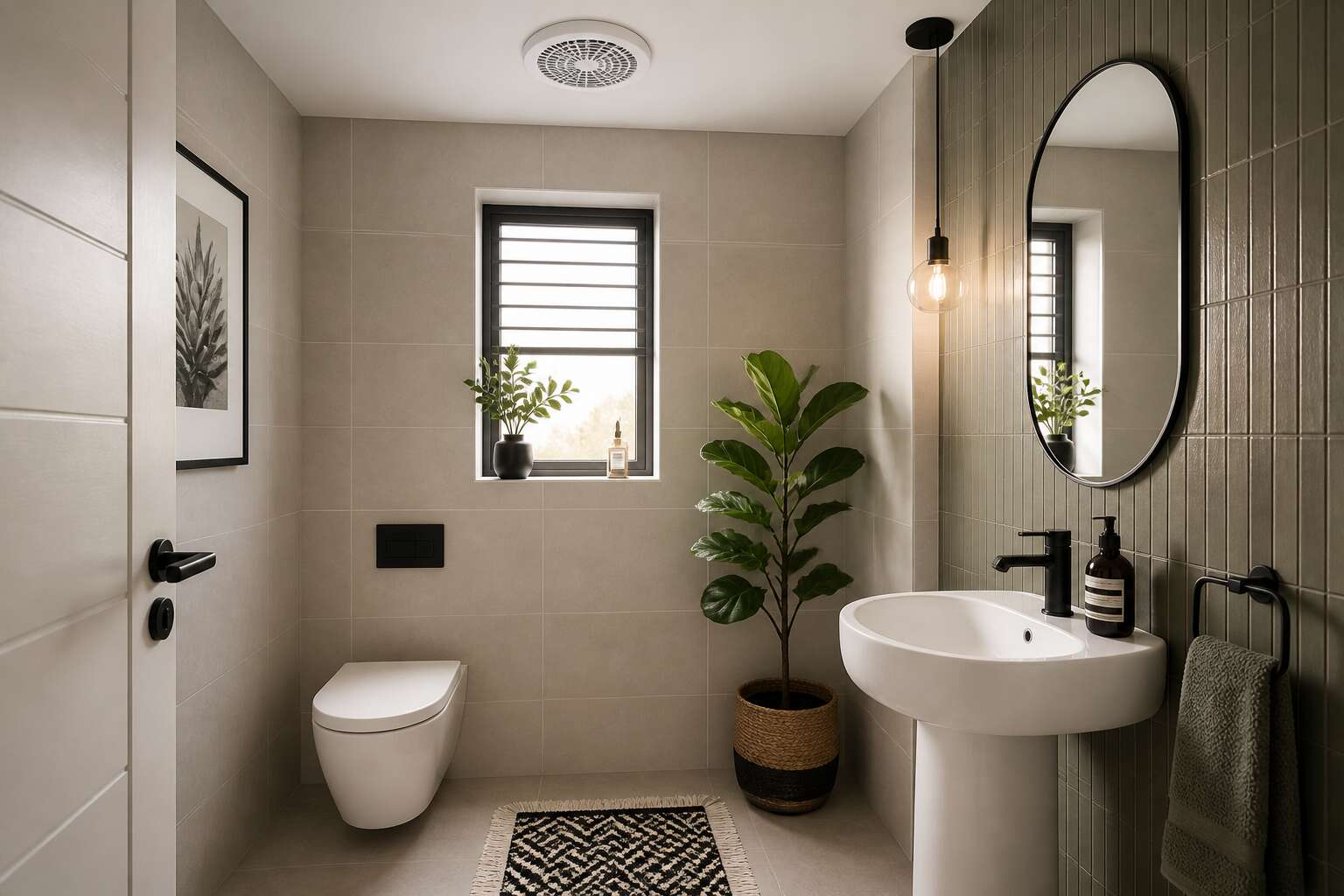
Why Guest Toilets Need Effective Ventilation
Health and Hygiene Benefits
Each flush sprays microscopic water droplets into the air, and those droplets can carry pathogens. In a guest toilet, which may be used by visitors who enter with colds or stomach bugs, the risk multiplies. Without proper air movement, moisture settles on surfaces, feeding mould colonies. A guest toilet extractor fan south africa handles this problem directly, constantly pulling contaminated air outside before it recirculates.
- It reduces condensation on walls and mirrors.
- It removes viruses and bacteria before they settle.
- It keeps the room fresh between visits.
The fan works silently in the background, but its benefit is tangible. Families with children and elderly relatives especially notice the difference, because a guest toilet should never be a source of sickness.
Preventing Mold and Mildew
In a country where humidity can turn any room into a terrarium, the guest toilet often becomes the silent victim of poor airflow. Condensation doesn’t need a leak or flood, a hot shower two rooms away drives moisture through the walls. That lingering dampness creates the perfect breeding ground for mold colonies. A guest toilet extractor fan south africa interrupts this cycle by continuously exchanging the air when the room is closed up between visitors. The result is a room that stays dry without intervention.
Mold formation is visual and physical. Stains on grout and that musty smell are just the opening act. Here is what unchecked humidity actually creates:
– Staining on ceilings, walls, and sealant that never scrubs clean
– A constant odour that masks itself as “old building smell”
– Painted surfaces that blister and peel within months
The room’s structural integrity suffers. An extractor fan does not need to run for hours, it just needs to be effective when active. Installing a guest toilet extractor fan south africa ensures the space dries out completely, avoiding costly repairs and preserving the finish of the fixtures. South African homes built with cavity walls and brick can trap moisture for extended periods, a problem that a bathroom rebuild will not solve on its own. Effective ventilation prevents the scenario where guests remember the dampness instead of the hospitality.
Odor Control
A guest toilet is a sealed world where scents linger like uninvited visitors. The air, once still, carries every trace of what happened before. A guest toilet extractor fan south africa pulls the atmosphere out before it settles into fabric, masks the next arrival, or clings to the walls until the next visit.
Odor control is not about covering smells. It is about removing the very particles that create them. The most persistent offenders arrive without warning.
– Biological residue left on surfaces after each use
– Chemicals from cleaning agents that mix into a cocktail of sharp scent
– Humidity carrying microscopic particles from hidden corners
The fan acts as a silent banishment, drawing the air away in an instant. South African homes, with their brick construction and closed layouts, hold onto these aromas far longer than an open plan dwelling. The result is a room that greets the next guest with indifference, not apology. It simply has no story to tell.
Humidity Reduction
Every flush releases a plume of moisture. Every hand wash sends steam toward the ceiling. In a guest toilet, these small acts create a persistent dampness no air freshener can touch. A guest toilet extractor fan south africa pulls that water-laden air out before it becomes a problem.
Consider the sources of moisture in any guest toilet:
- Steam from hand washing and towel drying
- Residual water on the basin and floor
- Humid air entering from the bathroom pipework
Without extraction, this moisture has nowhere to escape. South African homes with solid brick walls and sealed windows trap it inside. The right fan interrupts the cycle, exchanging stale, wet air for fresh, dry air in minutes. The room stays crisp, and the next guest opens the door to a space that feels clean, not clammy.
Key Considerations When Selecting an Extractor Fan for a Guest Toilet
Extractor Fan Types: Axial vs Centrifugal
I’ve seen countless installations go wrong simply because the duct run was longer than the fan could handle. A guest toilet extractor fan south africa must move air under real conditions, not just on paper.
Axial fans push air straight through the blades, making them fine for short wall vents. Centrifugal fans build pressure, so they push air through long ducts and around bends without stalling.
- Measure your duct length first
- Count the bends in the run
- Check the fan’s static pressure rating
Ignoring these numbers leads to weak airflow and a noisy unit. The right choice starts with geometry, not price.
Size and Airflow Capacity (CFM)
Most South African guest toilets measure under 3 square metres, yet that confined volume still demands a properly sized fan. Airflow capacity is measured in cubic feet per minute or CFM. The formula starts with the room’s volume. Multiply width by length by ceiling height, then multiply by the recommended air changes per hour, usually 8 to 10 for a toilet. That gives you the minimum CFM required for effective extraction.
- Measure the floor area precisely, including alcoves
- Multiply the volume by 8 to 10 air changes per hour
- Convert the result to cubic feet per minute
A guest toilet extractor fan south africa selected without this calculation will either underperform or waste electricity. The right unit matches the space, no more, no less.
Noise Levels
The quiet of a guest toilet is often the only silence a visitor experiences in your home. Yet a poorly selected extractor fan can shatter that brief reprieve with a grating whir that echoes through the walls. Noise levels are not merely an afterthought in the selection process. They are the defining factor between a functional utility and an intrusive annoyance.
Manufacturers rate sound output in sones, a unit that measures perceived loudness. While decibels indicate raw pressure, sones reflect how the human ear actually interprets the sound. A fan rated at one sone is roughly equivalent to a quiet refrigerator, while four sones begin to intrude on normal conversation. For a guest toilet extractor fan south africa, the goal is a unit that operates below two sones without sacrificing the airflow you calculated earlier.
The physical construction and installation method matter. A centrifugal fan, particularly one with an insulated casing, will dampen mechanical vibration more effectively than a cheap axial unit. Consider also where the ducting terminates and whether the fan is mounted on a thin partition wall, which can transmit noise into adjacent rooms. The attention you pay to these details determines whether the fan becomes invisible background hum or a memorable flaw in your hospitality. A quiet guest toilet extractor fan south africa respects the sanctity of the space, making the room feel more private and more considered.
Aesthetics and Design
The guest toilet extractor fan south africa is typically the smallest mechanical object in the room, yet it commands the most visual attention. After you have squeezed in the basin and hung the towel ring, the grille becomes the final architectural statement. A plastic, yellowed unit with a push-button timer can communicate neglect faster than a cracked tile. Design here is not about luxury; it is about coherence. The fan should either disappear into the ceiling or become a deliberate part of the wall treatment.
– Match the grille finish to your tapware, brass with brass, chrome with chrome.
– Measure the aperture before purchase; retrofitting a larger unit into an existing hole is a headache.
– Look for a louvred or recessed flange that sits flush against the plaster for a cleaner seam.
– Choose a square grille if your tiles are large format, round grilles suit smaller, moroccan layouts.
The texture of the fan matters. A glossy white grille on a matte painted wall will glare under a downlight, drawing the eye to every fingerprint. Eggshell or satin finishes hold up better in a humid environment and show fewer water spots. Some premium units offer a magnetic grille that snaps off for cleaning, which means you avoid prying at a brittle plastic catch with a butter knife. The positioning also influences the perception of the room. A fan mounted high on the wall near the shower valve hides the ducting run and feels less clinical than one centered above the door.
Many buyers now treat the fan as a styling cue. Wood-look or charcoal fronts are available for those embracing a darker, moodier palette. If the guest toilet is a showcase for a specific aesthetic, the extractor does not have to fight it. When the fan matches the room’s hardware, the guest toilet extractor fan south africa becomes a quiet confirmation of the homeowner’s attention to detail. That subtle alignment often makes the difference between a room that feels finished and one that feels merely equipped.
Installation Requirements for Extractor Fans in South African Homes
Electrical Regulations and SANS Compliance
Few homeowners realise that an extractor fan’s installation is governed by the Occupational Health and Safety Act. In South Africa, a guest toilet extractor fan south africa must be wired according to SANS 10142-1, the national wiring code. This regulation dictates conductor sizing, earthing, and earth leakage protection. As an electrician once told me, the work is straightforward, but the rules are strict. A registered person must handle the wiring and then issue a Certificate of Compliance, your proof for insurance and resale. Municipalities sometimes request an inspection to verify the isolation switch and circuit breaker. Moisture and electricity are a dangerous pair. Compliance is a safety barrier, not a bureaucratic hurdle.
Positioning and Ducting
The mounting spot dictates airflow. A fan mounted low only moves air across the floor. Mount it high on the wall, opposite the door, and it pulls air through the entire room. The duct run matters just as much. For a guest toilet extractor fan south africa, the outlet pipe should travel the shortest possible route to an external wall.
Rigid ducting outperforms flexible ducting. Flexible pipes have ridges that catch air and add noise. Keep the duct straight. Each 90 degree bend reduces extraction capacity by roughly twenty percent. Secure the exterior grille with a backdraft shutter to stop insects and cold air entering.
A few positioning rules:
- Mount the fan 150 to 300 mm below the ceiling.
- Keep the fan clear of the doorway path.
- Terminate ducting outdoors, never into the ceiling void.
Venting to the Outside
Every guest toilet extractor fan south africa installation carries a silent obligation to the outside world. The termination point is not a mere hole in the wall. It is the final gasp of stale air, the expulsion of humidity that would otherwise gnaw at paint and corrode metal fittings. In coastal regions, the salt-laden air can be merciless on unprotected outlets, demanding a robust, corrosion-resistant grille. The exterior louvre must be sealed meticulously against the masonry. A gap here is an invitation for drafts and a pathway for inquisitive geckos.
Venting to the outside is a matter of physics and law. Moisture that is not expelled will find the coldest surface and settle there. It will creep into the plaster and condense on the roof sheeting. In the highveld, the sudden drop in temperature after a storm makes this condensation event particularly aggressive. The duct must be insulated where it passes through a ceiling void, or the warm, moist interior air will condense before it ever reaches the fan.
– Terminate the duct a minimum of 300 mm away from any window or door opening.
– Ensure the exterior grille is fitted to allow the condensate to drain outward, not back into the house.
– Use a UV-resistant sealant around the external flange to prevent cracking and water ingress.
A guest toilet extractor fan south africa that terminates correctly will draw the vapor out and leave the room dry. A fan that terminates into a soffit or a roof cavity is a failure. It merely transports the moisture problem from one wooden beam to another. The journey of the air, from the grille on the internal wall to the open atmosphere, must be short, airtight, and direct. Any flexible ducting that suffers compression will strangle the airflow, turning a vigorous extraction into a weak sigh. The throat of the system, the wall hole itself, should be cut with a core drill to ensure a clean, circular opening that the rigid duct can fill completely. Seal every joint with foil tape, not a cloth tape that will degrade within a year. The final seal between the internal fan housing and the wall must be a bead of silicone, a thin black line that signifies the end of the battle against the damp. Only then does the system become a true guardian of the air.
Building Code Requirements
Building code requirements in South Africa are not suggestions. SANS 10400 Part O demands that a guest toilet extractor fan south africa be installed when the room lacks a window that opens. If you cannot open a window, you must mechanically move the air. The fan must circulate the room’s volume at least ten times an hour.
I sat through a municipal plan approval once while the inspector measured the floor area and did the calculation on a scrap of paper. For a guest toilet extractor fan south africa, the numbers must match the fan’s rated capacity.
The code also governs placement. The National Building Regulations require:
- A minimum distance between the fan and any opening window or door
- A certified electrician for the wiring connection
- A separate isolating switch for the fan
These details appear in the small print of the building plan. They matter when the municipality issues a compliance certificate. Without them, the certificate is delayed, and the sale of the property stalls.
Hiring a Professional Electrician
Wiring a guest toilet extractor fan south africa is not a weekend DIY project. I have seen the aftermath of a handyman’s shortcut: a scorched junction box and a voided insurance claim. The SANS regulations require a certified electrician for the final connection. That person signs the Certificate of Compliance, which is your legal proof the installation is safe.
A professional will also verify the isolator switch placement. You want that switch accessible, outside the moist zone, and clearly labelled. Here is what the electrician checks:
- The fan’s earth connection is properly bonded
- The circuit is rated for the fan’s amperage
- The ducting route has no sharp bends that restrict airflow
Hiring a certified electrician for your guest toilet extractor fan south africa protects your property and your family. That callout fee is minor, and the inspection is thorough!
DIY vs Professional Installation
I have walked into guest toilets where the air holds a secret: the ghost of a failed DIY extraction system. The silence is telling. The fan is mounted, yet the room still carries the damp weight of an unfinished shower. That is the true cost of bypassing the requirements for a guest toilet extractor fan south africa.
DIY installation tempts the pragmatic homeowner. A fan, a drill, an afternoon. What the hardware store does not sell is certainty. A poorly sealed vent can discharge moist air into the ceiling void, where it rots the timber over years, unseen. The wall cavity becomes a secret garden for mould, and the first sign is a dark stain that bleeds through the paint.
- DIY: The fan is wired, but the earth connection is an afterthought.
- Professional: The unit is rated for continuous operation, matched to the room volume.
- DIY: The ducting kinks at the first joist, strangling the airflow.
- Professional: The installer verifies the route, ensuring the extraction is unimpeded.
Compliance is not a suggestion. A guest toilet extractor fan south africa without a Certificate of Compliance is an heirloom of liability. The professional leaves behind more than a working fan; they leave a documented record that the installation will not betray you when the lights flicker. I have seen the alternative. It is a lesson best borrowed, not lived.
Popular Extractor Fan Brands and Models in South Africa
Top Brands: Soler & Palau, Vent-Axia, and More
Choosing a guest toilet extractor fan south africa often feels like a lottery, but the marque you select dictates whether that small space breathes or suffocates. Trust me, a flimsy unit will leave you warding off the invisible, and you do not want that in a guest loo. Two names dominate the local electrical aisles with an almost cult-like following: Soler & Palau and Vent-Axia.
Soler & Palau, or S&P as the sparkies call it, is the stalwart for raw, no-nonsense air movement. Their units handle the heat and humidity of a Durban summer without a whimper. Vent-Axia counters with sleek, whisper-quiet motors that make their presence known only through performance. For Renowned brands, the list is short, but the quality is clear:
– Soler & Palau for sheer durability and a massive range of local stockists.
– Vent-Axia for low-noise operation and contemporary grille designs.
– Nu-Air for budget-friendly retrofit options that still meet basic SANS specs.
The real truth is that the best brand rarely changes, but the model selection must match your specific ducting length. A long run to the outside will throttle a cheap axial fan, but a mixed-flow S&P will push the air out with authority. Buy a trusted name, and the guest toilet extractor fan south africa becomes a silent ally, not a buzzing nuisance.
Budget-Friendly Options
Across local suppliers, the Soler & Palau TD silent series dominates midrange sales. Yet the entry tier holds surprises for anyone hunting a guest toilet extractor fan south africa. Vent-Axia’s Lo-Carbon line reduces power draw dramatically, while Nu-Air produces no-fuss centrifugal units for under R500.
I often recommend the Acorn AX range for tight budgets. These axial fans handle short straight ducts and come in a white grille that disappears into the ceiling. The noise level is acceptable for a powder room.
- Acorn AX100: compact, basic, perfect for a direct wall vent.
- Nu-Air NA150: mixed flow for longer runs without the premium price.
Popular models shift seasonally, but the reliable core stays consistent. A guest toilet extractor fan south africa needs only enough static pressure to overcome its assigned pipework.
Premium Features: Humidity Sensors, Timers
Premium models push beyond raw airflow. Humidity sensors respond to the actual moisture load in the room, not a timer’s guess. This matters for a guest toilet extractor fan south africa, where usage is sporadic and silent failure is worse than no fan at all. A sensor triggers extraction only when the air thickens, saving electricity and reducing background noise.
Timers offer a different kind of control. They extend run time after the light switches off, clearing lingering odours without leaving the motor running all night. Some units combine both, with an adjustable overrun period that suits the room’s volume.
The psychological comfort is real. Guests notice the absence of clamminess more than they notice the fan itself. That quiet assurance is what separates a functional powder room from a memorable one.
Where to Buy: Retailers and Online Stores
Shopping for a guest toilet extractor fan south africa means knowing which models actually move air in this climate. The Soler & Palau SILENT range handles small powder rooms well, while the Greenwood inline units suit longer duct runs. Vortice models cope with coastal humidity without corroding.
Start your search at these outlets:
- Builders Warehouse for entry level axial fans
- ACDC Express for inline centrifugal units
- Takealot for fast delivery and price comparison
- Voltex for commercial grade stock
When you need a guest toilet extractor fan south africa delivered quickly, online retailers often beat physical stores on price. Just confirm the model supports 220V 50Hz power and carries the SANS approval mark before you pay. Imported fans without that certification will fail inspection.
Maintenance and Troubleshooting for Extractor Fans
Cleaning and Servicing Tips
A fan that labours silently in your guest toilet often goes unnoticed until the moment it fails. Dust and humidity can reduce airflow by half within a year. For a guest toilet extractor fan south africa, where coastal salt and Highveld dust add their own strain, regular attention is not optional.
Cleaning is straightforward. Switch off the power at the isolator first. Remove the cover and wipe the blades with a damp cloth. Check the ducting for blockages and listen for rattles.
- Inspect the backdraft shutter for free movement.
- Vacuum the motor housing with a soft brush attachment.
- Replace worn gaskets to stop condensation dripping back.
If the motor hums but the blades stay still, the capacitor likely needs replacing. A guest toilet extractor fan south africa in a moist environment may suffer corroded terminals; clean them with contact cleaner. Regular servicing extends the fan’s life beyond warranty.
Common Issues and Fixes
When a guest toilet extractor fan south africa starts misbehaving, the signs are usually subtle at first. A rattle that only appears after the unit warms up, a faint electrical smell, or a delay before the blades spin up all point to specific faults rather than a dying motor.
Most common problems fall into predictable categories:
- Loose mounting screws causing vibration noise
- Accumulated grime on the impeller throwing off balance
- A failing capacitor that leaves the motor humming without rotation
- Backdraft flaps stuck open or closed due to debris or corrosion
The capacitor issue deserves special attention. It is the component that gives the motor its starting kick, and when it weakens, the fan may need a manual nudge to get going. I have seen this exact scenario in older installations, where the fix is a simple replacement part costing a fraction of a new unit.
Another overlooked culprit is the isolator switch itself. Loose wiring or a worn contact point can starve the motor of power, mimicking a more serious electrical fault. For a guest toilet extractor fan south africa, where humidity and temperature swings accelerate component wear, these intermittent failures often appear long before the end of the product’s rated life.
When to Replace Your Extractor Fan
A guest toilet extractor fan south africa demands a peculiar form of respect. It works silently until a visitor steps inside and expects fresh air. When the fan hesitates or hums without spinning, many assume the end has come. The opposite is often true. The motor winding outlasts every other component, so a simple part swap restores function.
Troubleshooting is mostly observation. A fan that runs but moves little air signals a clogged impeller. One that rattles after warming up points to loose fittings. These are small adjustments, the kind any attentive homeowner can manage.
Replacement becomes the honest choice when the unit shows deeper wear:
- Corrosion has eaten through the housing
- The motor overheats within minutes of operation
- Moisture has damaged the electrical terminals
A guest toilet extractor fan south africa that has endured a decade of humid summers has earned its retirement. Knowing when to stop repairing is a form of hospitality.
Upgrading for Better Performance
Maintenance often reveals the limits of an older unit. A guest toilet extractor fan south africa that once performed admirably may now struggle with new humidity levels or longer ducting. Regular cleaning and bearing checks extend life, but they cannot restore lost efficiency.
Upgrading becomes the practical response when troubleshooting shows the motor draws excessive current or the impeller has warped. Newer models offer backward curved blades and EC motors that draw less power.
- Shaft play and bearing noise
- Impeller balance after cleaning
- Terminal corrosion on the wiring side
The choice to upgrade should follow measurement, not habit. If the old unit clears steam in ninety seconds and the new one does it in forty, the cost earns its return. A guest toilet extractor fan south africa operates best when its components match the room’s actual demands.


0 Comments