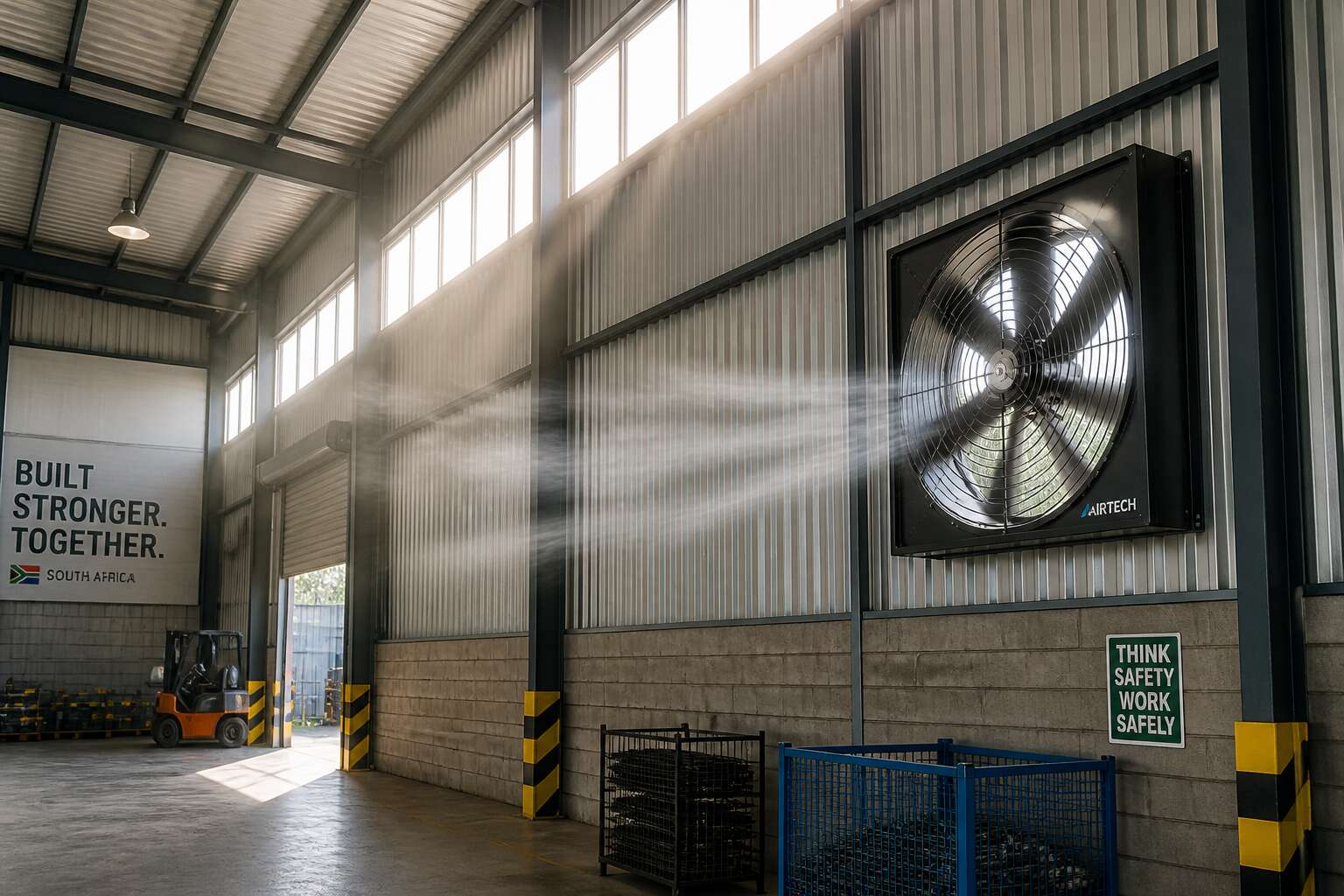
Industrial Ventilation Challenges in South African Warehouses
Climate Conditions and Temperature Extremes Across Provinces
Walk into a Durban warehouse in February and you feel the humidity pressing on your skin. Coastal moisture pushes perceived temperatures past 40°C, while a Johannesburg facility in winter can sit at 5°C by dawn. These extremes shape product integrity, staff endurance, and ventilation hardware lifespan.
I have seen this play out across provinces. The Northern Cape endures intense summer heat. Gauteng swings between day and night temperatures. The Western Cape faces cold, damp winters. A single national approach to ventilation fails when regional conditions vary this much.
- Highveld warehouses face afternoon heat spikes above 35°C despite cool mornings
- Coastal regions contend with salt-laden air that corrodes standard hardware
- Interior provinces experience rapid temperature drops that stress roof-mounted systems
That is why choosing a warehouse extractor fan south africa has to start with your province’s climate profile! A generic specification sheet cannot capture what your warehouse will face.
Common Air Quality Issues in Storage Facilities
Air inside a warehouse holds more than inventory. Dust from packaging, chemical off-gassing from stored goods, and biological particulates linger at breathing height, often unseen by workers until symptoms appear. These are the contaminants that drive the need for a warehouse extractor fan south africa solution that can handle specific airborne threats rather than general airflow alone.
– Fine particulate matter from cement, grain, or recycled materials that settles on every surface
– Volatile organic compounds emitted by paints, solvents, and adhesives in storage
– Carbon monoxide from forklifts and loading equipment idling in confined spaces
The real issue is that poor ventilation does not announce itself loudly. Staff experience headaches, drowsiness, and reduced focus, but rarely connect those feelings to the air they are breathing. Over months, allergens and respiratory irritants accumulate in spaces where people work eight to twelve hour shifts.
I have walked through facilities where the air felt heavy before a single measurement was taken. That weight comes from stagnation. Without proper extraction, air pollutants layer on top of one another, turning a storage space into an environment that compromises worker health and product safety simultaneously. Solving this requires mapping contaminant sources first, then matching extraction capacity to real conditions on the floor, not just the building’s square footage.
How Poor Ventilation Affects Worker Health and Productivity
South African warehouses lose 18 working days each year to respiratory related absenteeism, a figure that climbs without mechanical extraction. Workers in poorly ventilated spaces operate at reduced capacity because their bodies are reacting to the air.
Physiological strain shows up as slowed decision making and decreased vigilance. When forklifts move between narrow aisles, that slowdown has consequences. Carbon monoxide exposure, at low levels, impairs reaction time before symptoms emerge.
- Reduced situational awareness during peak loading hours
- Longer cycle times for order picking and stock rotation
- Higher error rates on inventory counts and documentation
Industrial ventilation challenges extend beyond toxic gases. Humidity from coastal provinces accelerates corrosion of stored goods, while inland dust storms coat filters within weeks. A warehouse extractor fan south africa solution must handle these pressures, moving stale air out before performance degrades.
Warehouse managers measure air quality after complaints arise. By then, productivity has slipped.
Structural Factors That Limit Natural Airflow in Metal-Clad Warehouses
Metal-clad warehouses across Gauteng and Durban face a geometric problem: the materials that make them quick to erect also make them airtight. Corrugated steel sheeting offers few natural openings. Roof pitches are low, designed for rainwater runoff, not thermal buoyancy. Wall heights create tall columns of still air that stratify heat at ceiling level. The result is a building envelope preventing natural airflow.
Natural airflow depends on pressure differentials and unobstructed paths. These warehouses present obstacles at every turn.
- Cladding sheets are installed horizontally, trapping warm air in ribbing
- Loading bays and dock doors sit on one side only, preventing cross-ventilation
- Mezzanine floors and racking layouts block whatever breeze might enter
- Insulation layers add another barrier to airflow
Without mechanical assistance, these structures cannot self-ventilate. A warehouse extractor fan south africa operation must overcome this geometry, pulling air out of a building never designed to let it escape naturally.
Seasonal Variations and Their Impact on Indoor Environments
South African seasons do not merely change the weather; they completely rearrange the interior atmosphere of a metal-clad warehouse. Winter mornings produce condensation dripping from steel roofs. By afternoon, the same building transforms into a heat collector, with ceiling temperatures that make workers reconsider their career choices.
Summer brings its own absurdity. Durban’s coastal humidity turns stored goods into reluctant sponges, while Gauteng’s thunderstorm season creates sudden pressure shifts. These fluctuations mean ventilation needs are never static. A system sized for May will be inadequate by September.
- Winter condensation promotes rust and mould growth
- Summer heat accelerates chemical off-gassing from stored products
- Spring winds stir up dust from forgotten corners
This is why a warehouse extractor fan south africa installation must account for seasonal shifts. Designing for average temperatures guarantees failure during peak conditions.
Selecting the Right Extraction System for Large-Scale Facilities
Calculating Air Movement Capacity and Cubic Meter Requirements
Calculating air movement capacity begins with the physical volume of your facility. For a 5,000 square metre warehouse with a 10 metre eaves height, you are moving 50,000 cubic metres of air. That figure drives every subsequent decision. A warehouse extractor fan south africa must match this volume per hour, adjusted for roof pitch, racking density, and internal obstructions.
The standard approach uses air change rates. General storage spaces typically need six to ten changes per hour. Multiply your total cubic metres by the desired rate to arrive at the extraction capacity. This calculation seems simple, but it leaves room for error.
- Underestimating heat gain from forklifts and electrical equipment.
- Ignoring pressure drops caused by long or convoluted duct runs.
- Overlooking that a warehouse extractor fan south africa performs differently at high altitudes or in coastal humidity.
Account for these variables before finalising your system. The difference between a theoretical number and actual performance often comes down to honest measurement. Choosing the right extraction system means matching cubic metre requirements to real-world conditions, not just spec sheets.
Matching Blade Materials to Corrosive or Dusty Environments
In coastal provinces, salt-laden air corrodes standard steel blades within months. Inland, fine dust from grain or cement clings to poorly finished surfaces. Blade material determines the difference between longevity and failure.
The blade material of a warehouse extractor fan south africa must be matched to the particulate it will encounter. Aluminium blades resist rust but soften under abrasion. Coated carbon steel holds up in dry, dusty sheds. Stainless steel, though costlier, suits humid or chemically charged spaces.
Consider what your air actually carries:
- Salt spray near the coast
- Fine organic dust from bulk storage
- Ammonia fumes from cold rooms
That list narrows the choice faster than any brochure. When the extractor spins, each grain of dust tests the material. I have watched a wrong blade fail in under a season, and a stopped fan costs the whole operation in lost throughput.
Single-Phase vs. Three-Phase Motor Considerations
Most facilities discover their motor problem after the first heatwave. The fan turns, but the air stays stale. That is when motor phase becomes an operational crisis. A warehouse extractor fan south africa on 230V single phase serves a modest shed, but a large facility with long duct runs needs three phase. Three phase motors start under load with less current draw and hold speed under dust loads.
Points that matter for large floor areas:
- Voltage drop over long cable runs when the switchboard sits far from the fan.
- Starting torque. Three phase accelerates the impeller without straining the supply.
- Spare capacity. Three phase leaves room for expansion without rewiring.
I have watched operators blame a good fan when the real fault was a motor chosen for the wrong supply. For a warehouse extractor fan south africa, the phase choice shapes cable thickness and breaker rating. It deserves attention early.
Roof-Mounted vs. Wall-Mounted Extraction Setups
Roof mounted fans draw heat and stale air upward, where it naturally wants to escape. Wall mounted units serve facilities with limited roof access or where targeted airflow across specific aisles matters more. For a warehouse extractor fan south africa, the decision depends on building geometry, roof pitch, and maintenance access.
Consider what each approach offers:
– Roof mounted systems clear large volumes of stratified heat from high ceilings.
– Wall mounted fans cost less to install and are easier to reach for servicing.
– A mixed configuration handles mezzanine levels and partitioned storage areas.
Roof mounted extraction suits high bay warehouses where warm air collects near the roof line. Wall mounted extraction works better for smaller structures with low ceilings. The wrong mounting position turns a capable fan into a source of noise and drafts. A warehouse extractor fan south africa must match the structure it serves, not just the motor rating. Measure your building before you choose.
Cost vs. Long-Term Operational Efficiency
An extractor fan that costs R50,000 to buy might burn R40,000 in electricity annually. That arithmetic should frame every purchasing decision for a warehouse extractor fan south africa, especially in large-scale facilities where dozens of units run simultaneously.
The real comparison happens over years, not at the point of sale. A low upfront quote often hides less efficient motors, thinner housings, and shorter service intervals. Those differences compound across a 10,000 square meter floor.
Evaluate each proposal on the same set of criteria:
- Total cost of ownership per unit over a ten year period.
- Annual energy consumption at typical operating hours.
- Maintenance frequency and replacement part availability.
Energy consumption per cubic meter moved should guide your decision. In my experience, the cheapest quote rarely wins once running costs are included.
Legal Compliance and Safety Standards for Warehouse Ventilation
Occupational Health and Safety Act Requirements for Industrial Airflow
Holding a single staff member accountable for an OSHA-compliant environment is a legal requirement, not an administrative preference. In South Africa, the Occupational Health and Safety Act (Act 85 of 1993) forces employers to provide a working environment that is safe and without risk to health. When dust, fumes, or excessive heat accumulate, the employer has technically failed this duty of care. I see many facility managers focus on machinery guards and fire escapes, yet they neglect the invisible threats in the air they expect their teams to breathe for eight hours. Ignoring airflow is a liability issue that can surface during an inspection or after an incident.
The regulations do not specify a particular brand or blade size, but they mandate performance outcomes. Your ventilation system must effectively remove airborne contaminants and maintain thermal comfort. If a worker develops respiratory issues due to poor air quality, the burden of proof shifts to the business owner to show that reasonable steps were taken. Installing a warehouse extractor fan south africa is often the most direct method to satisfy these requirements. The risk assessment process, which is mandatory, must include an evaluation of the ventilation rate and its effectiveness in real working conditions.
Documentation is your first line of defense, but air movement is your physical proof. A compliance file filled with policies means nothing if the air is stagnant and heavy. To align with the act, you must ensure the selected equipment can handle the toxic load specific to your stored goods. For facilities handling volatile compounds, the extraction system must be spark-proof and properly earthed. For general storage, the priority shifts to dilution of carbon dioxide and regulation of humidity. Either way, the law demands that the system is maintained and that employees are trained on its operation.
Consider the hierarchy of control measures your compliance team uses:
1. Elimination of the hazard at the source.
2. Substitution with a less harmful process.
3. Engineering controls, such as mechanical ventilation.
4. Administrative controls like shift rotation.
5. Personal protective equipment as a last resort.
A warehouse extractor fan south africa falls into the engineering controls category, which is the most effective solution after hazard elimination. Relying on workers to wear masks or open dock doors is a weaker defense that exposes the company to legal risk. The act interprets your duty broadly, meaning you must anticipate potential exposure, not just react to visible problems. Investing in proper exhaust capacity is not an operational preference; it is a statutory obligation that protects both your workforce and your legal standing.
SANS Regulations Relevant to Ventilation Equipment
Municipal inspectors have a strange habit of reading the fine print. SANS 10400 Part O demands specific ventilation rates, and your occupation certificate hangs on those measurements. The South African Bureau of Standards does not accept the argument that the loading dock doors count as a ventilation system.
Equipment that meets a warehouse extractor fan south africa specification must be certified against the applicable SANS standards. The compliance checklist is not enormous, but it is exact:
- Ventilation openings sized to the floor area and occupancy
- Mechanical extractors with fire-rated ducting
- Electrical enclosures rated for the dust or moisture class
Deviations from the approved building plans will stall your certificate of occupation. Align the installed equipment with the drawings, keep the certificates on file, and let the airflow argue for you.
Fire Safety Considerations With Extraction Fan Placement
Fire does not respect paperwork, and it certainly does not wait for a compliance officer to finish their tea. In a warehouse where the air moves poorly, a small electrical fault can become a ceiling of flame in minutes. The extractor fan becomes part of the fire defence, not just a comfort device. When a warehouse extractor fan south africa unit is positioned correctly, it actively steers smoke and heat away from evacuation routes, giving people the seconds they need to get out. The trick is to place the fan with the building’s internal obstacles in mind, not just the roof pitch.
A common mistake is mounting extractors directly above storage racks. That placement pulls flames upward and accelerates the spread. Instead, the fans should sit close to the fire-rated partition lines, creating a pressure differential that keeps smoke away from exits. Consider the following placement rules:
1. Keep a minimum distance of three metres from any flammable storage racking.
2. Position fans to draw air from the main aisles, not from dead-end corners.
3. Ensure the ducting has a fire damper rated for at least two hours.
The electrical enclosure on your warehouse extractor fan south africa must also carry the correct ingress protection rating. A standard motor can arc in a dusty environment, turning the fan into an ignition source. That is the fine line between a ventilated space and a sealed hazard. The system should cut power automatically if the internal temperature spikes, which is a simple relay function that many suppliers offer as standard. The fan’s job is to clear the air, but only while it remains a tool, not a catalyst.
Ensuring Electrical Compliance With South African Wiring Codes
Electrical compliance for a warehouse extractor fan south africa unit begins with SANS 10142, the wiring code that governs every industrial installation. A fan connected to a non-compliant circuit is a liability that no certificate can resolve.
The wiring must handle the fan’s starting current, which far exceeds its running load. Your electrician should verify the circuit breaker rating, the cable sizing, and the earthing arrangement before the blades spin.
- Confirm the isolator sits within sight of the fan.
- Check that earth leakage protection matches the motor’s draw.
- Verify the certificate of compliance reflects the actual installation.
Municipal inspectors and insurers review these details. A warehouse extractor fan south africa installation that fails the wiring code will halt operations and void cover.
Installation, Maintenance and Energy Optimisation Strategies
Best Practices for Unit Placement and Airflow Direction
A single degree of blade angle changes a warehouse extractor fan south africa performance. Installation planning starts with measuring pressure differences across the structure. Fans near heat sources create stronger extraction paths than randomly placed units. Airflow direction matters as much as capacity. A forced air pattern pushing contaminated air toward the extraction point reduces dead zones. Short, straight duct runs improve efficiency. Long bends add resistance and consume energy.
Maintenance protects the investment. Dust on propeller edges and safety grilles reduces extraction by as much as 15% each month. Cleaning intervals depend on the storage environment. Professional inspections catch wear before motor failure.
Energy optimisation follows unit placement. A warehouse extractor fan south africa operates most efficiently when aligned with natural airflow patterns. South African warehouses often receive prevailing winds from the southwest. Units on the leeward side let natural pressure assist mechanical extraction. Temperature sensors limit off peak running.
Routine Cleaning Schedules to Prevent Dust and Debris Buildup
Every warehouse extractor fan south africa earns its keep only when its blades cut clean air. A routine cleaning schedule is not a luxury; it is the difference between a system that extracts steadily and one that labors against its own grime. Dust binds to propeller edges, and debris lodged behind safety grilles reduces airflow measurably. I have seen extraction rates drop by a third in facilities that skip a single month of maintenance!
Installation quality matters too. A fan mounted with inadequate clearance recirculates the same contaminated air, and that waste appears directly on the energy bill. Once the unit sits correctly, the cleaning rhythm takes over:
– Wipe propellers and grilles weekly in dusty storage environments.
– Inspect motor housings monthly for residue buildup.
– Schedule quarterly professional checks for belt tension and bearing wear.
Energy optimisation follows naturally. A clean fan moves more cubic meters per kilowatt, so the warehouse extractor fan south africa works less and lasts longer.
Troubleshooting Common Motor and Belt Failures
Installation quality determines how much stress a warehouse extractor fan south africa endures. A misaligned mounting point creates vibration that travels through the motor housing and shortens bearing life. Check the foundation plate for levelness before final tightening. Even a 2 mm offset can cause premature belt wear.
For maintenance, torque checks matter more than visual inspections. Loose set screws on pulleys are a common failure point. I always verify alignment with a straightedge rather than trusting the eye.
Energy optimisation starts with belt tension. An overtightened belt wastes power and heats the motor. A loose belt slips and reduces extraction speed. Use a deflection gauge for accuracy.
Troubleshooting common failures:
- Motor hums but does not start: check the capacitor and thermal overload relay.
- Belt squeals on startup: adjust tension or replace worn pulleys.
- Motor overheats: confirm the phase voltage matches the nameplate rating.
These checks keep the system running efficiently.
Reducing Energy Consumption With Automated Thermostat and Humidity Controls
Correct installation determines how effectively a warehouse extractor fan south africa performs throughout the year. Mount the unit on a vibration dampening base to reduce stress on the motor housing. Check the frame with a spirit level before tightening bolts. Uneven surfaces cause imbalance that shortens belt life.
Maintenance should follow a documented schedule rather than reactive fixes. Clean blades and housing regularly to prevent dust accumulation. Inspect belts monthly for cracks or glazing. Replace worn components before they fail completely.
Automated thermostat and humidity controls reduce energy consumption by running the warehouse extractor fan south africa only when conditions require it. Sensors monitor internal air quality and adjust speed accordingly. They respond to:
- Rising humidity that creates condensation on stored goods
- Heat buildup from machinery during peak production hours
- Night temperature drops that eliminate extraction needs
This avoids unnecessary operation during mild weather and prevents overcooling in winter. The result is lower electricity bills without sacrificing ventilation quality.
UV-Resistant Coatings and Corrosion Protection for Coastal Regions
Salt-laden air is the primary threat to coastal warehouses. A warehouse extractor fan south africa installed near the ocean experiences accelerated corrosion on exposed metal surfaces. The marine environment attacks fan housings, mounting brackets, and fasteners with equal persistence, degrading components that inland facilities rarely worry about.
UV-resistant coatings form the first line of defence. These finishes prevent solar degradation of paint layers that would otherwise expose bare metal to corrosive agents. Corrosion protection demands attention to the complete assembly:
- Stainless steel fasteners replacing galvanised bolts
- Powder-coated housings with marine-grade primers
- Sealed motor casings to block salt particles from windings
Routine inspection of a warehouse extractor fan south africa in coastal regions should target rust bloom around weld points and sharp edges. Touching up scratched areas promptly stops corrosive spread beneath the coating. Fans with compromised finishes fail prematurely, and replacement costs far exceed the price of preventive maintenance.
Retrofitting Older Warehouses With Modern Fan Technology
Retrofitting older warehouses demands a different approach than new builds. Existing roof structures may not support modern fan units without reinforcement, so a structural engineer should assess load-bearing points first. Older buildings often contain asbestos sheeting, which complicates mounting and requires certified removal specialists before installation proceeds.
Energy optimisation arrives through variable speed drives that modulate airflow to match real-time demand. Newer fan models also incorporate direct-drive motors, eliminating belt maintenance and reducing energy losses. A warehouse extractor fan south africa installed during a retrofit benefits from:
- Access platforms for safe servicing at height
- Quick-release panels that simplify filter cleaning
- Remote monitoring that alerts managers to performance drops
These retrofitted systems typically pay back their installation cost within three years through electricity savings alone.
Evaluating Costs, ROI and Available Support in the South African Market
Budgeting for Capital Expenditure and Installation Labor
Factoring in the prevailing exchange rate and import duties, the true cost of a warehouse extractor fan south africa often extends beyond the catalogue price. Capital expenditure must include mounting hardware, electrical isolation switches, and sometimes structural reinforcement for roof sheeting. Installation labor in major metros such as Johannesburg or Durban varies significantly, so obtaining three certified quotes is prudent before committing.
Support availability also shapes the ROI for any warehouse extractor fan south africa investment. A supplier with local stockholding reduces downtime when a motor fails during peak season. These variables often determine the final payback period:
- Warranty terms that cover corrosion, not just mechanical failure
- Spare parts response time within your specific province
- After-hours maintenance availability for night shifts
A cheaper unit requiring expedited overseas shipping rarely delivers the same long-term value as a locally supported system.
Comparing Electricity Tariffs and Operating Cost Projections
South Africa’s average industrial electricity tariff has climbed more than 340% over the past decade. That single figure reshapes every cost projection for a warehouse extractor fan south africa. Municipal rates vary sharply across provinces, often by nearly thirty percent, which alters the payback period before installation even begins.
Operating cost projections must account for time-of-use structures and seasonal demand charges. A unit running during peak windows in Gauteng costs considerably more per hour than the same model under flat municipal billing in the Western Cape.
Consider these variables when modelling ROI:
1. Your specific municipal tariff structure and Eskom rebate eligibility.
2. Expected daily runtime across summer and winter production shifts.
3. Motor efficiency ratings and blade design under real operating conditions.
A locally supported warehouse extractor fan south africa allows you to adjust control settings and maintenance intervals with confidence, knowing that spares and technical expertise remain within reach when peak season strains every system.
Government Incentives or Rebates for Energy-Efficient Equipment
Evaluating government incentives for energy-efficient equipment in South Africa requires patience and a calculator. The Section 12B tax allowance under the Income Tax Act covers renewable energy assets, but a warehouse extractor fan south africa rarely qualifies unless integrated with a solar installation. The Energy Efficiency and Demand Side Management programme offers limited relief, though municipal participation determines accessibility. Eskom’s Integrated Demand Management rebates fluctuate with funding cycles, so timing matters.
For most operators, the realistic ROI calculation depends on Eskom rebate eligibility rather than headline grant figures. The paperwork burden often exceeds the benefit for a single unit, but bulk retrofits across multiple facilities tip the scale. A local warehouse extractor fan south africa supplier who manages the rebate administration simplifies things considerably. A delayed payout erodes net present value, so that administrative support carries more weight than the nominal rebate amount.
Sourcing Replaceable Parts and Availability of Technical Technicians
When evaluating a warehouse extractor fan south africa purchase, the installed cost only tells part of the story. Spare parts availability and technician response times shape the real return on investment. A fan that sits idle for three weeks while waiting for an imported bearing costs more than the premium price of a locally supported unit.
Technical expertise varies across provinces. In Gauteng and the Western Cape, certified ventilation technicians are within a day’s travel. In rural Northern Cape, you may rely on a supplier’s remote diagnostics or a travelling service team. Ask suppliers for a maintenance contract that includes scheduled inspections and priority callouts.
- Confirm that belts, motors, and blades are stocked locally before purchase.
- Check whether the supplier offers training for your in-house maintenance staff.
- Request a written response-time guarantee for breakdowns.
This due diligence converts a simple procurement into a long-term operational asset.



0 Comments