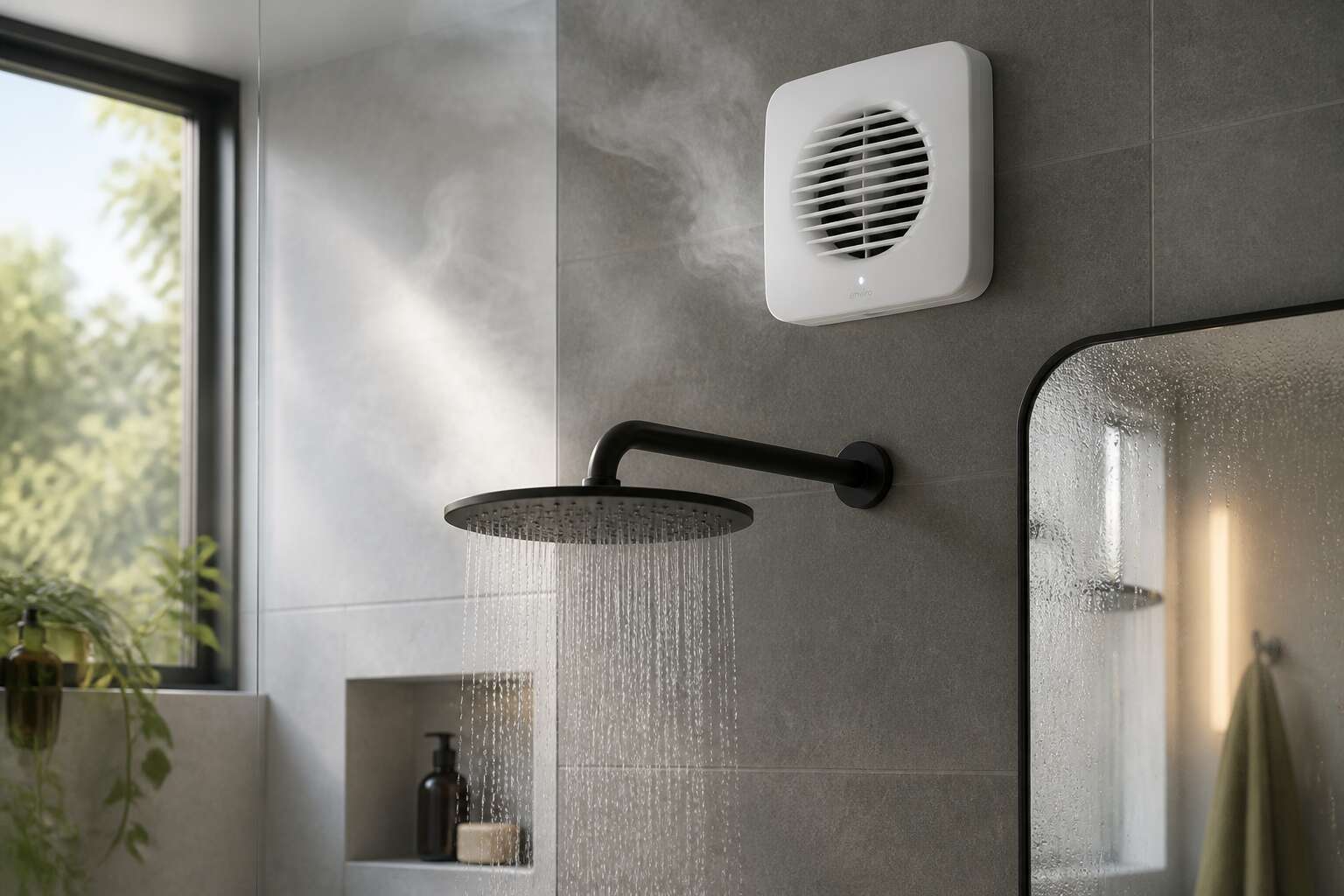
Why Bathroom Ventilation is Essential for South African Homes
The Impact of Coastal Humidity and Rainy Seasons
South Africa’s coastal regions bring a unique challenge to home maintenance. The air carries salt and moisture, especially during the rainy season. I have seen bathrooms without proper airflow become breeding grounds for mildew and peeling paint. A bathroom moisture extractor fan south africa can mitigate this persistent humidity. Consider the typical winter rainfall in the Western Cape or summer storms in Durban. Each leaves walls damp for hours. Ventilation is a structural necessity, not a luxury! Without it, timber frames rot and grout discolours. Common effects of poor ventilation include:
- Persistent condensation on tiles
- Odours that linger after showers
- Allergens that aggravate respiratory conditions
The rainy season amplifies these problems. In coastal towns like Gqeberha, humidity often exceeds 80 percent. That moisture finds every crack. A bathroom moisture extractor fan south africa pulls damp air outward before it settles. This protects your health and your home’s integrity.
Preventing Black Mould and Allergens in the Home
Mould spores wait for one thing: a surface that stays damp beyond forty-eight hours. South African bathrooms create exactly that condition. I have opened cupboards in Pretoria to find hinges filmed with black spots. A bathroom moisture extractor fan south africa removes moisture at the source. It denies mould the dampness it needs to reproduce.
The health effects are less visible but more damaging. Allergens from mould and dust mites circulate into the whole home, triggering asthma episodes and sinus infections. Mould threatens more than appearances.
– It releases mycotoxins that inflame airways
– It feeds on soap scum left by showers
– It colonizes grout and silicone seals
A bathroom moisture extractor fan south africa keeps these contaminants moving outward. Without it, you breathe the residue of everything that evaporated in your bathroom. That alone should end the debate!
Protecting Windows, Mirrors, and Wooden Fixtures
A mirror can cloud beyond usability within minutes, but the real damage unfolds slowly. Moisture seeps into wooden frames, lifts varnish, and warps door edges. I have watched bathroom cupboards swell shut within two seasons. A bathroom moisture extractor fan south africa changes that trajectory. It pulls humid air away before it ever settles on surfaces.
The list of casualties is steady:
– Mirrors lose their silver backing at the edges
– Wooden skirting develops hairline cracks
– Hinges and handles corrode despite chrome plating
A bathroom moisture extractor fan south africa keeps these materials dry. That preservation is not cosmetic. It saves you from replacing fixtures that should last decades.
Critical Features to Evaluate When Choosing a Ventilation Unit
Calculating the Right Airflow Capacity (L/s or CFM)
Choosing a bathroom moisture extractor fan south africa requires looking beyond the price tag. Motor quality, blade design, and noise rating all affect long-term performance. A fan with sealed ball bearings handles humid conditions better than cheaper sleeve bearings, and a corrosion-resistant casing extends the unit’s lifespan.
Airflow capacity sits at the core of the decision. Measured in litres per second (L/s) or cubic feet per minute (CFM), the rating determines how quickly steam clears. A standard 3m by 2m bathroom needs roughly 54 L/s to extract moisture effectively, while larger spaces or rooms with deep bathtubs demand more.
Compare these features when evaluating units:
– Timer settings to keep extraction running after you leave
– Humidity sensors that trigger the fan automatically
– Backdraft shutters to prevent external air from reversing the flow
A lower CFM rating uses less electricity, but it will fatigue against sustained dampness, leaving tiles slippery and walls cold.
Understanding Noise Ratings for Comfortable Living
Noise is the silent failure point of most ventilation units. Selecting a bathroom moisture extractor fan south africa demands scrutiny of components that determine daily comfort. A fan’s noise output, measured in sones rather than decibels alone, tells you how the unit will feel in a quiet morning routine. Below 1.5 sones is barely perceptible; above 4 sones, conversation becomes strained.
Evaluate these elements before purchase:
- Humidity-triggered activation for hands-free operation
- Low-wattage motors that sustain airflow without drone
- Corrosion-resistant housing for coastal salt air
The best bathroom moisture extractor fan south africa balances sound with extraction efficiency. A whisper-quiet fan that moves little air leaves you with damp walls. One that roars may clear steam but ruins the calm of a bath. The right unit hums quietly and consistently, fading from conscious awareness while doing its work.
Energy Efficiency and Continuous Running Options
Energy efficiency in a bathroom moisture extractor fan south africa is a measure of how willingly the unit works when you are not watching. A fan drawing 8 watts continuously costs less per year than a 40 watt unit running intermittently, yet it keeps air moving steadily. The difference compounds over a decade of daily showers.
Continuous running options change the relationship between the fan and the room. Instead of reacting to steam after it forms, the fan maintains a gentle baseline airflow that prevents moisture from settling. This matters in bathrooms without windows, where humidity has nowhere to go.
- Humidity sensors that trigger boost mode only when needed
- Low standby power draw in continuous running units
- Timer overrides for manual control when required
The quiet hum of a continuously running fan becomes part of the room’s atmosphere, barely noticed but always present.
Integrated Sensors: Humidity, Motion, and Timer Controls
The most profound shift in modern ventilation is the sensor array. A bathroom moisture extractor fan south africa equipped with a humidity sensor responds to the actual water vapor in the air, not a schedule. It waits for the shower to raise the relative humidity before it activates. This intelligence prevents the room from becoming a breeding ground for mildew without wasting electricity on a pre-set timetable.
Many units feature a motion detector for hands-free operation and a timer function for post-shower drying. The timer is a critical tool for clearing residual steam after you leave. Without it, the moisture stays trapped overnight.
– Humidity sensor triggers the fan only when the air reaches a set saturation point
– Motion detection provides immediate activation upon entry, capturing steam from the first second
– Timer modes allow a prolonged run cycle to flush out damp air completely
These sensors create an adaptive system. They turn a passive appliance into an active participant in the home’s air quality, reacting to the specific, daily rhythm of your household. This is the quiet intelligence of a modern bathroom moisture extractor fan south africa.
Compliance with South African Building and Electrical Standards
Navigating SANS 10400 Regulations for Natural Ventilation
A bathroom window that opens is not enough to satisfy South Africa’s national building regulations. SANS 10400 sets minimum natural ventilation requirements, but the rules also allow mechanical systems as an alternative. That alternative, a bathroom moisture extractor fan south africa, must meet specified airflow rates and discharge points.
Electrical compliance adds another layer. SANS 10142 governs the wiring, earthing, and IP ratings for fans installed in wet areas. A certified electrician should handle the connection, and local municipalities often require a certificate of compliance upon sale. The key points are:
- The fan must extract to the outside, never into a ceiling cavity.
- An isolator switch must be fitted within reach of the fan.
- The installation must match the rated capacity for the room volume.
Following these standards prevents costly rework and keeps a home insurable. Municipal inspectors check for these details during property transfers, and the latest SANS 10400 amendments change periodically.
Essential Electrical Safety: IP Ratings and Earthing Requirements
An extractor fan that works is one thing; an extractor fan that is safe is another. The bathroom moisture extractor fan South Africa installs in thousands of homes each year must comply with SANS 10142, the wiring standard for wet areas. This means more than just plugging it in.
The fan’s IP rating must be appropriate for its zone, typically IPX4 or better, to resist water splashes. Earthing is equally critical. A fault in the motor could otherwise electrify the metal housing. The fan must have a proper earth connection and be connected through an isolator switch. According to SANS 10142, the installer must provide an earth leakage protection device. The IP rating protects against moisture ingress; earthing protects against electric shock. Both are non-negotiable.
Never assume a fan is rated for bathroom use just because it looks like one. Check the label and the certificate of compliance. Municipal inspectors will look for these details during a property transfer, and insurance companies may reject claims if the installation was not certified.
Mandatory Ventilation for Windowless Bathrooms and Toilets
Under SANS 10400 Part R, any bathroom or toilet lacking a natural opening to the outside must have a bathroom moisture extractor fan south africa hardwired into the structure. Municipal plan approval depends on this design element. The building inspector will look for the fan before issuing an occupancy certificate.
The bathroom moisture extractor fan south africa in an internal toilet must discharge through a duct that terminates at least 600mm from any opening. The duct cannot be shared with another unit unless engineered. This is a failure point in granny flats and office conversions.
- Duct runs should be smooth and as short as possible
- Terminate outside, never into a roof cavity
- Use a backdraught shutter to prevent return airflow
Buyers should verify that the fan exists before signing. I have watched estate agents list a bathroom as private ensuite, but the plan says otherwise.
Installation Challenges and Solutions for Local Dwellings
Retrofitting into Concrete Walls versus Superboard Partitions
Retrofitting a bathroom moisture extractor fan south africa often means confronting the wall itself. Concrete walls, built to outlast empires, resist drill bits with tedious enthusiasm. You might hit rebar mid-bore, which stops progress instantly. Superboard partitions present a different comedy! They crumble under an overzealous screwdriver, yet hide void spaces where ductwork rattles continuously.
Older homes add their own quirks:
- Uneven wall thicknesses mean a standard spade bit may not reach the exterior.
- Superboard, being brittle, needs pilot holes before cutting, or you get a hole shaped like Madagascar.
Masonry anchors suit concrete, but demand a masonry bit and a steady hand. For superboard, toggle bolts distribute the extractor’s weight, otherwise the unit migrates downward. The local housing stock simply refuses to offer a uniform surface, which is precisely why the correct hardware matters more than raw strength.
Ducting Lengths and Insulation in Attic Spaces
Attic spaces in South African homes trap furnace heat by midday and cold draughts after dark. A bathroom moisture extractor fan south africa depends on a clear path through this void, yet ducting runs seldom cooperate. Long lengths strangled by sharp bends reduce airflow by measurable margins, leaving humidity to pool inside the pipe. Rigid ducting holds its shape; flexible foil crushes beneath the first careless footstep. Insulation around the duct prevents condensation, which otherwise drips into the ceiling board and breeds rot. I measure every metre and every turn before committing to a fan’s position. The attic floor hides its own adversaries:
- uninsulated ductwork that sweats in winter
- joists and cabling forcing awkward detours
- compacted insulation hiding gaps in the vapour barrier
Each obstruction demands its own solution, and none announces itself beforehand.
Handling Cold Air Ingress and Backdraft Issues
Cold air ingress shows itself as a persistent draught beneath the bathroom door. A bathroom moisture extractor fan south africa fights that pressure difference whenever it runs. The trouble comes after switch-off. Warm moist air rises inside the duct, cools, and sinks back, carrying dust and roof cavity scents. I test each backdraft shutter before fixing the unit in place.
Gravity flaps handle mild coastal conditions, but Highveld winters produce negative pressure that lifts them clean off their seats. Spring-loaded dampers hold firmer. Some homes need both:
- a backdraft damper at the fan outlet
- a roof cowl with its own counterweighted flap
Cold air pooling beside the geyser finds every gap. The duct entry where it passes through the ceiling board stays a weak point. Cape Town houses with sash windows see pressure shift with the wind, and a bathroom moisture extractor fan south africa installed without attention to these currents pulls cold air from the hallway instead of moisture from the shower.
Choosing Between Wall-Mounted and Ceiling-Mounted Units
Choosing where to mount a bathroom moisture extractor fan south africa involves geometry, building physics, and luck. Wall-mounted units face the cavity wall problem. In Cape Town, that cavity hides timber, insulation, or a colony of restless geckos. Drilling in without inspecting first is a gamble.
Ceiling-mounted fans sound tidy, but they demand roof access. Estate agents call it a “loft space.” In reality, you are crouching on battens while the Highveld wind makes off with your hat. The prettiest ceiling spot often hides a truss.
- Wall mounts suit homes with an accessible exterior wall and a clear cavity.
- Ceiling mounts work only when the roof pitch allows a clean outlet.
I have swapped ceiling fans for wall units when the roof made installation impossible, and the bathroom moisture extractor fan south africa performed better for it.
Working with Sloped Roofs and Limited Clearance Areas
Sloped roofs punish careless measurements. A 15 degree pitch looks harmless from below, but in the ceiling void every centimetre counts. Ducting must rise before it exits. You kneel on insulation, fitting a bathroom moisture extractor fan south africa with one arm wedged between trusses.
Limited clearance creates its own issue. Some older Johannesburg homes have barely 300 mm of void. Standard axial fans will not fit. A compact inline unit mounted further along the run solves it.
When the geometry is tight:
- Smooth bore flexible duct handles tight bends.
- Mount the fan body in an adjoining cavity.
- Cut a soffit vent instead of a roof penetration.
Each fix alters pressure, which changes the effective duct length. A bathroom moisture extractor fan south africa that works on paper can stall if the sloped roof pinches the outlet.
Best Practices for Maintenance and Troubleshooting
Weekly and Monthly Cleaning Routines to Maximise Performance
A fan left uncleaned loses up to 40% of its airflow within three months. Dust sticks to the impeller, and the motor strains against the extra load. In South African homes, airborne dust and humidity create a sticky film on the blades.
Remove the grille monthly and wash it in warm soapy water. Vacuum the motor housing every quarter to prevent debris from clogging the vents. Check the backdraft flap for obstructions, a stuck flap allows outside air to enter. If the fan rattles, tighten the mounting screws. If it hums without spinning, the capacitor is failing.
Coastal properties require extra vigilance, with salt air accelerating wear on electrical connections:
– Inspect terminals for corrosion
– Replace the grille if it warps
A clean bathroom moisture extractor fan south africa operates silently and efficiently.
Common Electrical Faults and How to Address Them Safely
Electrical faults demand respect before the grille ever comes off. Isolate the circuit at the distribution board first. A bathroom moisture extractor fan south africa runs on live current, so never assume the wall switch kills the power. Confirm with a voltage tester before touching any terminal.
Humming without rotation, tripped breakers, and intermittent operation usually trace back to a failing capacitor, loose terminals, or a worn bearing. Examine wiring connections for discolouration, melting, or a brittle insulation feel.
- Verify the capacitor’s microfarad rating matches the motor specification
- Test the supply voltage at the terminal block with a multimeter
- Inspect the isolator switch for burn marks or a stiff toggle
Replace damaged components with identical parts rather than improvisations. If the fault remains unclear, call a certified electrician. A bathroom moisture extractor fan south africa homeowners trust depends on proper handling of live circuits, and a mistake here carries serious consequences.
Upgrading Your System for Improved Air Quality and Efficiency
When a bathroom moisture extractor fan south africa begins showing its age, the repair versus replacement decision deserves honest evaluation. Older units often lack the static pressure needed to push air through long duct runs, especially after renovations add extra bends. A fan that struggles to clear steam will eventually let moisture settle on walls and fittings.
Upgrading the impeller or motor assembly can restore performance within a housing that already fits your wall cavity. Modern backward curved impellers move air more quietly than the forward curved designs common in budget fans. That change alone can shift the system from noisy and sluggish to unobtrusive and responsive.
- Check the fan’s extraction rate against your bathroom volume
- Measure the available duct diameter before ordering parts
- Compare the running wattage against newer models
An upgraded bathroom moisture extractor fan south africa also improves air quality through better filtration options and a higher IP rating for coastal environments. The result is a quieter, more efficient system that handles the humidity loads you actually generate.


0 Comments